Correct option is C
Let's analyze the Western blot results and the co-IP findings to determine which interpretation is incorrect.
Protein P interacts with chaperone H and co-chaperone A (Correct).
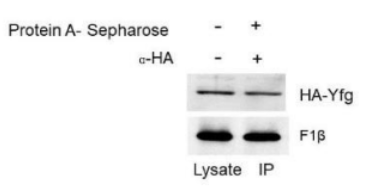
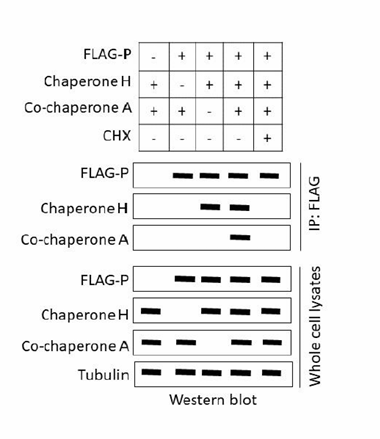
- The co-IP results show bands for both chaperone H and co-chaperone A when FLAG-P is present, indicating that protein P interacts with both chaperones.
Chaperone H interacts only with newly synthesized protein P (Correct).
- When CHX (cycloheximide) is added, which inhibits protein synthesis, the interaction between chaperone H and protein P is significantly reduced.
- This suggests that chaperone H primarily interacts with newly synthesized protein P.
Interaction between co-chaperone A and protein P is independent of chaperone H (Incorrect).
- The co-IP results indicate that co-chaperone A interacts with protein P only when chaperone H is also present.
- This suggests that co-chaperone A requires chaperone H for its interaction with protein P, meaning that the interaction is dependent on chaperone H.
Interaction between chaperone H and protein P is independent of co-chaperone A (Correct).
- The interaction between chaperone H and protein P occurs even in the absence of co-chaperone A, as shown in the co-IP bands where chaperone H is present regardless of co-chaperone A.
- This means the interaction is independent of co-chaperone A.
Thus, the incorrect statement is Option 3, as co-chaperone A's interaction with protein P depends on chaperone H.
Information Booster
- Cycloheximide (CHX) inhibits new protein synthesis, helping determine if chaperone binding is dependent on newly synthesized proteins.
- Chaperone proteins assist in protein folding, stability, and complex formation.
- Co-chaperones often require the presence of primary chaperones for interaction with target proteins.
- Co-immunoprecipitation (co-IP) is used to study protein-protein interactions under different conditions.
- If an interaction disappears with CHX treatment, it suggests that the protein binds to newly synthesized substrates.
- If an interaction remains after CHX treatment, it suggests a stable interaction with mature proteins.