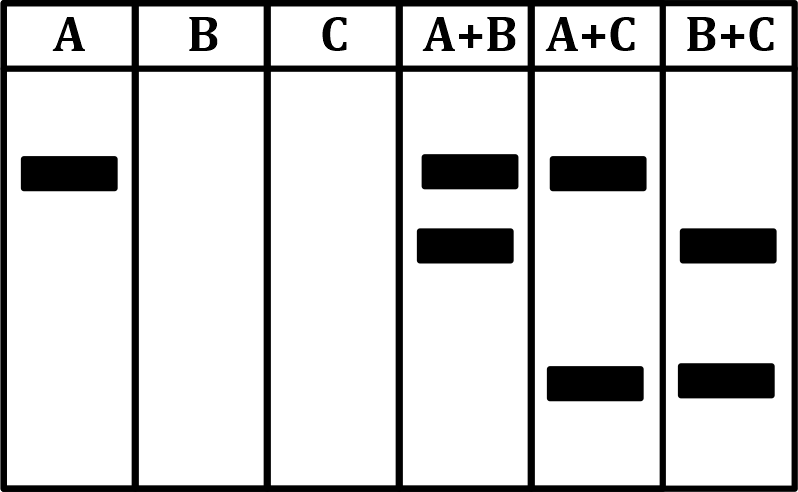
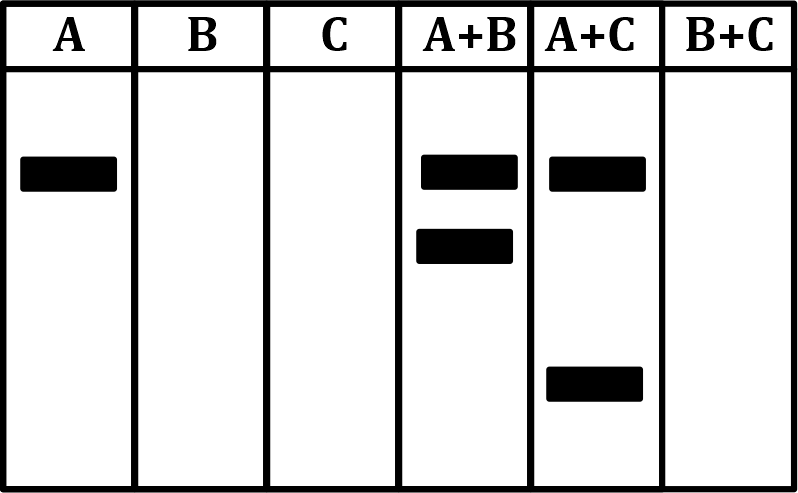
Correct option is A
Explanation:
Construct A:
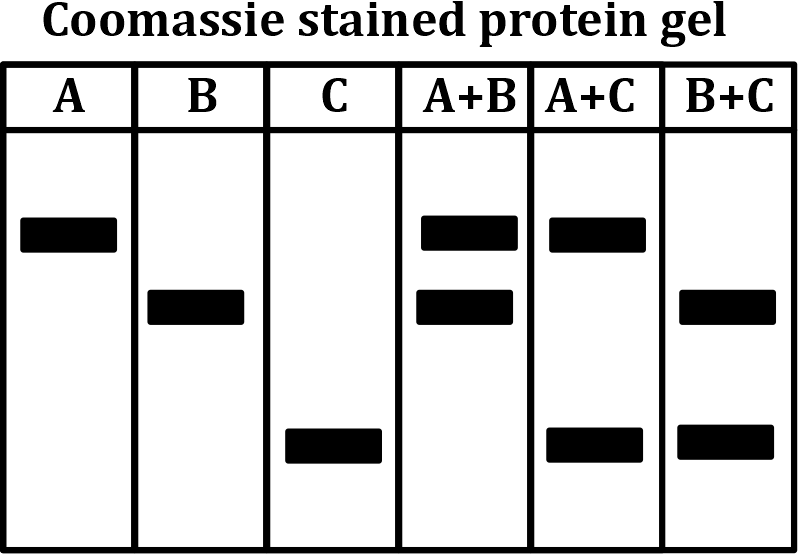
- Full-length RTK with a functional kinase domain and 3 tyrosine residues.
- This construct can dimerize and autophosphorylate upon binding.
- When treated with ATP in the presence of a ligand, this construct will show strong bands in the autoradiogram due to autophosphorylation, indicating active signaling.
Construct B:
- RTK with a non-functional kinase domain but retains 3 tyrosine residues.
- While it can form dimers, it cannot autophosphorylate because the kinase domain is inactive.
- This construct will not show any autophosphorylation bands in the autoradiogram despite being present in the Coomassie stain because it cannot carry out phosphorylation.
Construct C:
- RTK that lacks the 3 tyrosine residues but has a functional kinase domain.
- Although it has an active kinase domain, it cannot perform autophosphorylation due to the absence of the necessary tyrosine residues.
- This construct may appear in the Coomassie-stained gel but will not show bands corresponding to autophosphorylation in the autoradiogram.
Analysis of the Expected Results:
Band Presence in Combinations:
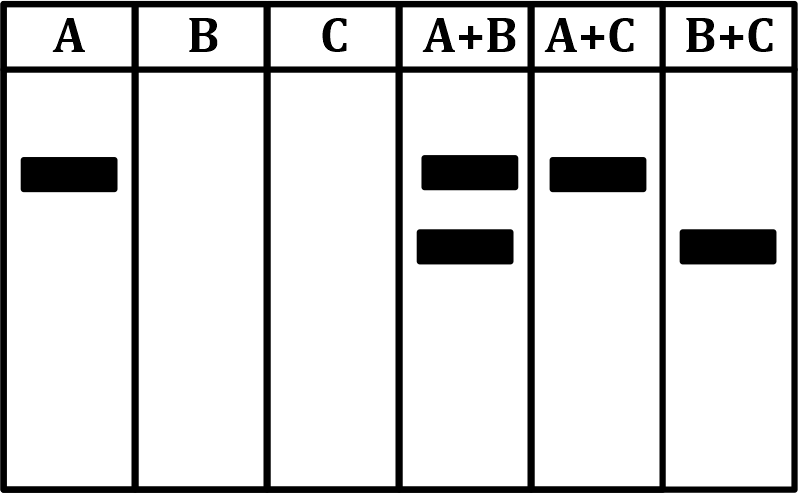
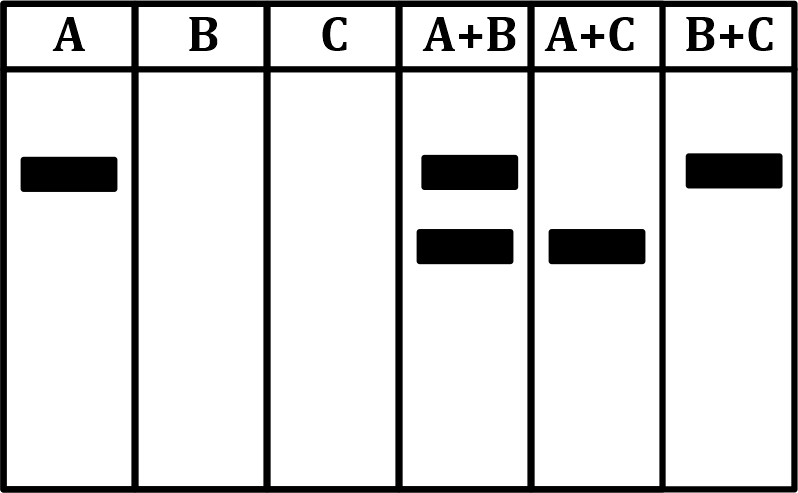
A + B:
- A has a functional kinase domain and will autophosphorylate, generating a band in the autoradiogram.
- B cannot phosphorylate itself, but it can be phosphorylated. Since B has tyrosine residues, it can receive phosphate groups from A when they are co-expressed.
- Result: The band seen in A + B comes solely from A and B.
A + C:
- A will again autophosphorylate, generating a band.
- C, although having a functional kinase domain, lacks tyrosine residues necessary for autophosphorylation, meaning it will not contribute any bands.
- Result: The band seen in A + C also comes solely from A.
B + C:
- B has tyrosine residues but cannot autophosphorylate itself. However, it can potentially be phosphorylated by C, which has a functional kinase domain. C can phosphorylate B, leading to bands showing that C has acted on B.
Summary of Bands:
- A + B: Band due to A autophosphorylating and phosphorylating B.
- C: Band due to A autophosphorylating; C does not contribute to the band.
- B + C: Band due to C phosphorylating B.