Correct option is A
Breakdown of the Immunoblots and Assumptions:
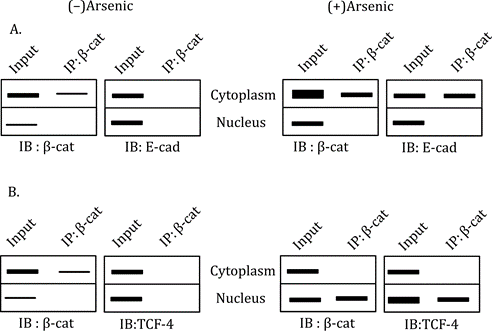
The immunoblot data represents HeLa cells treated with arsenic and analyzed for the following proteins:
β-catenin (β-cat)
E-cadherin (E-cad)
TCF-4 (transcription factor associated with Wnt signaling)
Assumptions:
A. Arsenic activates the non-canonical β-catenin pathway.
Correct: Based on the data, arsenic treatment leads to increased β-catenin in the cytoplasm, which suggests a possible activation of the non-canonical β-catenin pathway. In the canonical Wnt pathway, β-catenin translocates to the nucleus, whereas in the non-canonical pathway, β-catenin acts in the cytoplasm. The immunoblots show an increase in β-catenin levels in the cytoplasm, supporting the activation of a non-canonical pathway.
B. Arsenic leads to cellular proliferation.
Correct: Although the data does not explicitly measure cell proliferation, arsenic has been known to influence signaling pathways that are related to cell growth, including β-catenin. β-catenin is involved in regulating genes related to cell proliferation and survival. The activation of β-catenin signaling, as suggested by the data, could potentially lead to cellular proliferation, which aligns with this assumption. This is supported by the observed increase in β-catenin in the cytoplasm, which can lead to activation of proliferative pathways.
C. Arsenic leads to proteasomal degradation of β-catenin.
Incorrect: The data shows increased levels of β-catenin in the cytoplasm, indicating that arsenic does not cause proteasomal degradation of β-catenin. Instead, the data suggest that β-catenin is stabilized or accumulated, which is typical in non-canonical Wnt signaling. Proteasomal degradation would typically reduce β-catenin levels, not increase them, making this statement incorrect.
D. Arsenic induces apoptosis in the HeLa cells.
Incorrect: While arsenic can induce apoptosis in some contexts, the data does not explicitly show markers of apoptosis or cell death. The experimental focus is on changes in protein localization (β-catenin and TCF-4), not on apoptosis markers. Therefore, we cannot conclusively infer that arsenic induces apoptosis in HeLa cells based on the provided data.
Correct Combination:
Option 1 (A and B) is the correct answer because both Statement A and Statement B align with the experimental data:
Statement A (Arsenic activates the non-canonical β-catenin pathway) is supported by the increase in cytoplasmic β-catenin.
Statement B (Arsenic leads to cellular proliferation) is plausible because β-catenin plays a role in regulating cell proliferation, and the increased levels of β-catenin suggest activation of this pathway.
Information Booster:
Non-canonical Wnt pathway and β-catenin: In the non-canonical Wnt signaling pathway, β-catenin is often stabilized in the cytoplasm rather than translocating to the nucleus. This pathway regulates various cellular processes, including migration, adhesion, and proliferation. The increase in cytoplasmic β-catenin observed in the immunoblots suggests activation of this pathway.
Arsenic and cellular proliferation: Arsenic can influence various signaling pathways, including those that regulate cell survival and proliferation. The increase in β-catenin levels may activate target genes that promote cell proliferation.