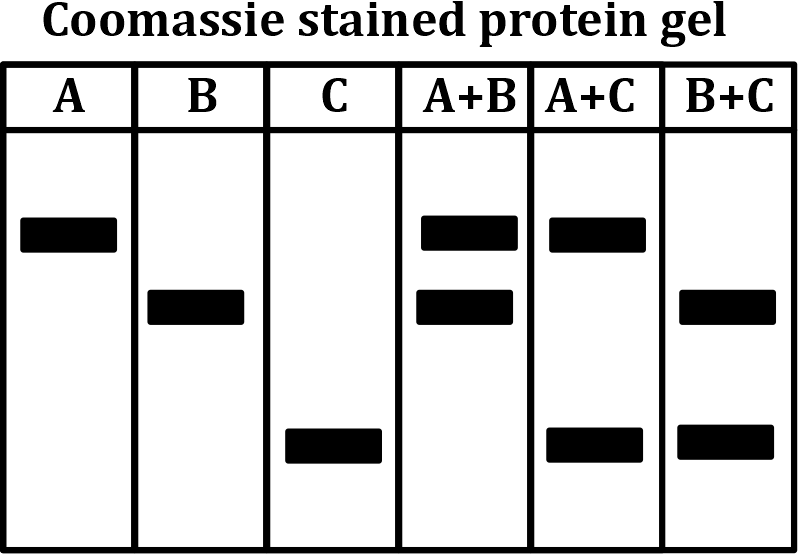
Correct option is A
Key Observations:
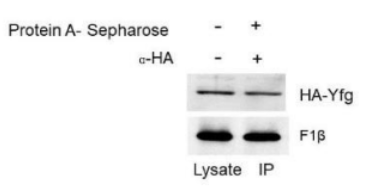
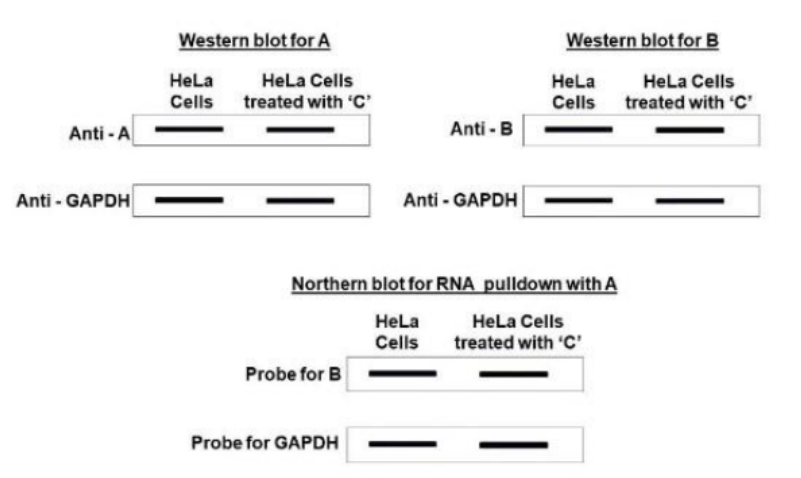
- Western blot for A: Protein A binding to transcript B is reduced or absent in HeLa cells treated with chemical C. This suggests that chemical C disrupts the interaction between protein A and transcript B.
- Western blot for B: The translation of transcript B is also reduced or absent in cells treated with chemical C. This suggests that the presence of chemical C disrupts the translation of transcript B, but not necessarily the binding of protein A.
- Northern blot for RNA pull-down with A: There is a reduced interaction between protein A and transcript B when chemical C is present, suggesting that mRNP disruption affects the interaction between protein A and transcript B.
Evaluation of the Options:
Option 1: mRNP disruption does not affect the interaction of protein A and transcript B, or the translation of transcript B.
- This is the correct answer. The data from the western blot for protein B suggests that the translation of transcript B is disrupted upon mRNP disruption, but it does not completely block protein A's binding to transcript B. The interaction between protein A and transcript B is diminished but not fully abolished. Therefore, mRNP disruption does not completely affect the interaction between protein A and transcript B. The translation of transcript B is also disrupted, but the disruption of translation is not because of protein A binding.
Option 2: mRNP disruption inhibits protein A interaction with transcript B but not the translation of transcript B.
- This is incorrect because the data shows that protein A's binding to transcript B is affected by the mRNP disruption. It is not just about translation; the interaction between protein A and transcript B is also reduced.
Option 3: mRNP disruption does not affect the interaction of protein A and transcript B but disrupts the translation of transcript B.
- This is incorrect because protein A's binding to transcript B is indeed affected. The data shows that mRNP disruption reduces the interaction between protein A and transcript B.
Option 4: mRNP disruption promotes protein A interaction with transcript B and translation from transcript B.
- This is incorrect because the data shows that mRNP disruption reduces protein A's interaction with transcript B, and the translation of transcript B is also affected.