Correct option is A
Analyzing Each Statement:
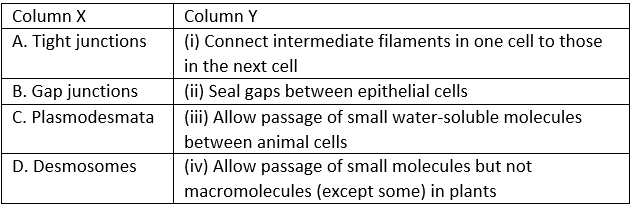
A. Tight junctions are cell-cell junctions connecting the intermediate filament in one cell with that in the adjacent cell.
Incorrect: Tight junctions are not involved in connecting intermediate filaments between cells. Tight junctions are primarily responsible for creating a barrier that seals the space between adjacent cells, preventing the passage of molecules. They are not related to intermediate filaments but are involved in maintaining cell polarity and controlling the passage of solutes.
B. Desmosomes are cell-matrix anchoring junctions connecting actin filament in one cell to the extracellular matrix.
Incorrect: Desmosomes are cell-cell anchoring junctions, not cell-matrix junctions. They connect intermediate filaments of adjacent cells, not actin filaments, and serve to provide mechanical strength to tissues by linking cells together. The statement incorrectly describes desmosomes' function and their involvement with actin filaments.
C. Gap junctions are channel-forming junctions allowing the passage of small water-soluble molecules from cell to cell.
Correct: Gap junctions are indeed channel-forming junctions that allow the direct passage of small molecules, ions, and water-soluble molecules between adjacent cells. This statement is true and correctly describes the function of gap junctions.
D. Tight junctions are occluding junctions that seal the gap between two cells.
Correct: This statement is accurate. Tight junctions function as occluding junctions that seal the gaps between adjacent cells, preventing the free flow of substances between them and maintaining the integrity of the epithelial barrier.
E. Hemidesmosomes are cell-matrix anchoring junctions connecting intermediate filaments in one cell to the extracellular matrix.
Correct: Hemidesmosomes are indeed cell-matrix anchoring junctions, and they connect intermediate filaments in the cell to the extracellular matrix. This statement accurately describes the function of hemidesmosomes.
Identifying the Combination of Incorrect Statements:
Incorrect statements:
A (about tight junctions)
B (about desmosomes)
So, the correct combination of ALL INCORRECT statements is A and B.