Correct option is A
Explanation:
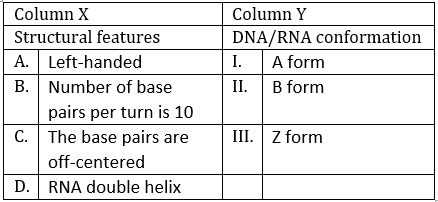
A. Left-handed
This describes Z-DNA, which is a left-handed helical structure.
Match: A → (iii) Z form
B. Number of base pairs per turn is 10
The common B-DNA has about 10 base pairs per turn.
Match: B → (ii) B form
C. The base pairs are off-centered
This is a feature of A-DNA, where the bases are tilted and displaced from the axis of the helix.
Match: C → (i) A form
D. RNA double helix
RNA double helices resemble the A-form rather than B or Z forms.
Match: D → (i) A form
Information Booster:
B-DNA: The most common DNA conformation under physiological conditions, right-handed, with ~10 bp per turn.
A-DNA: A right-handed form of DNA, more compact with bases tilted and displaced from the helix axis. RNA double helices also resemble A-form.
Z-DNA: A left-handed DNA helix with a zigzag backbone. It forms under specific conditions and is less common.
RNA Double Helix: Due to the 2’-OH group on ribose, RNA favors the A-form conformation.