Correct option is D
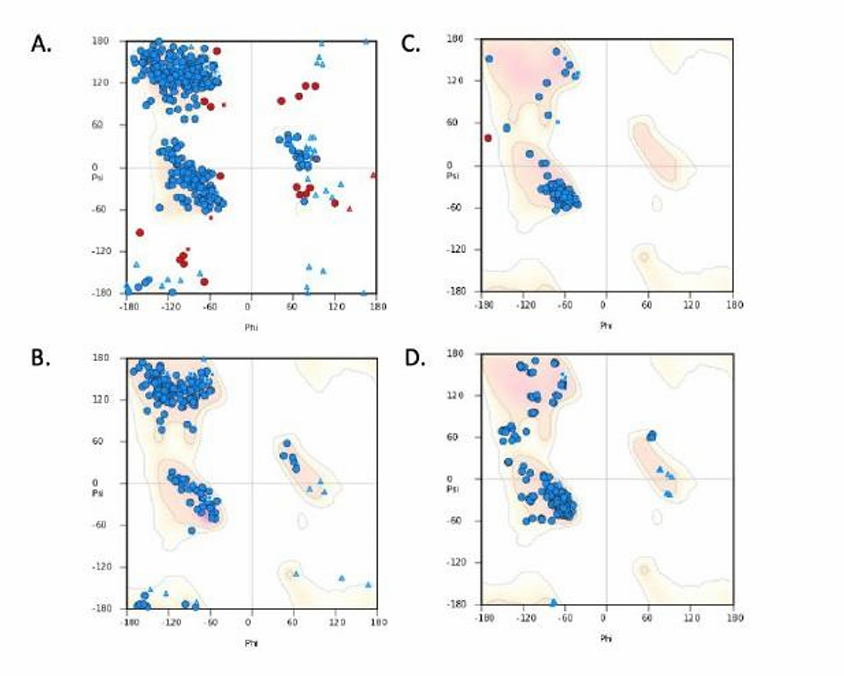
- Plot A shows points distributed across multiple regions, suggesting that the protein has mixed secondary structures and is not predominantly alpha-helical.
- Plot B has points clustered predominantly in the lower-left quadrant, which indicates the presence of alpha-helices.
- Plot C also has points predominantly in the lower-left quadrant, indicating a structure that is predominantly alpha-helical in nature.
- Plot D shows a similar clustering in the lower-left quadrant, confirming that it is also predominantly alpha-helical.
Thus, Plots C and D are both predominantly alpha-helical, making Option 4 (C and D) the correct choice.
Information Booster: Alpha-Helical Structures
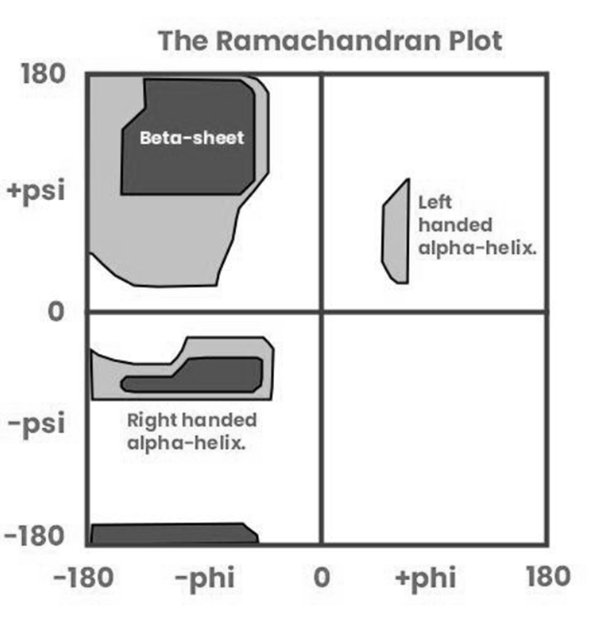
Alpha helices are secondary structures that form a right-handed helix, stabilized by hydrogen bonds between the carbonyl oxygen of one residue and the amide hydrogen of another residue located four residues away. The dihedral angles of alpha helices typically fall around:
- ϕ (phi): -60°
- ψ (psi): -50°
These dihedral angles place the data points for alpha-helical structures in the lower-left quadrant of a Ramachandran plot. Plot C and Plot D both exhibit this characteristic pattern, confirming that they represent predominantly alpha-helical structures.
Additional Knowledge: Understanding Other Secondary Structures
Plot A (Mixed secondary structures):
This plot has points spread across various regions, including areas for alpha helices, beta sheets, and random coils. This suggests a more complex structure rather than a predominantly alpha-helical one.Plot C (Predominantly alpha-helical):
Although the initial assessment might suggest a beta-sheet structure, a closer look reveals a dominant clustering in the alpha-helical region, confirming this plot is primarily alpha-helical.Beta-Sheet Regions:
Beta sheets are characterized by ϕ around -120° and ψ around 120°, placing them in the upper-left quadrant of the Ramachandran plot. These regions are not predominant in Plot C or Plot D, which further strengthens the evidence for the answer.
Thus, C and D are the correct pair of proteins that are predominantly alpha-helical in nature.