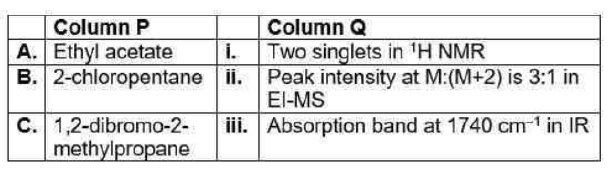
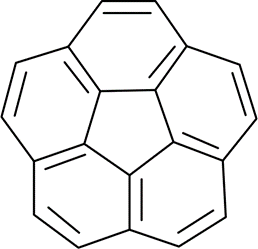
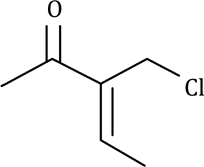
Correct option is D
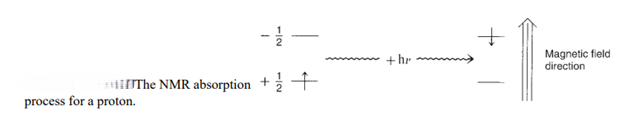
The nuclear magnetic resonance phenomenon occurs when nuclei aligned with an applied field are induced to absorb energy and change their spin orientation with respect to the applied field.
The energy absorption is a quantized process, and the energy absorbed must equal the energy difference between the two states involved.
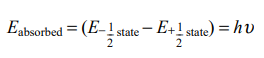
In practice, this energy difference is a function of the strength of the applied magnetic field B0
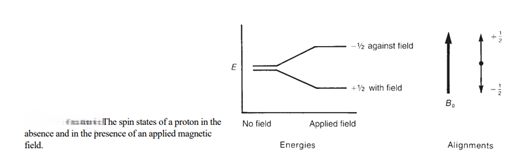
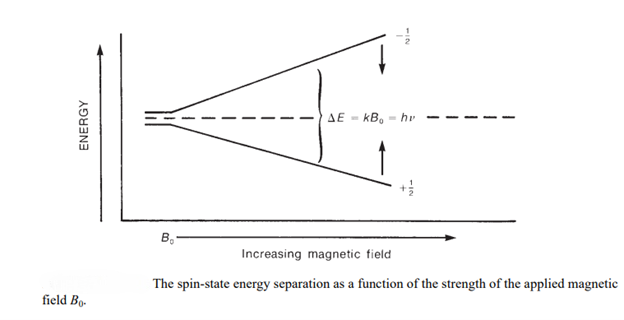
The stronger the applied magnetic field, the greater the energy difference between the possible spin states:

The magnitude of the energy-level separation also depends on the particular nucleus involved. Each nucleus (hydrogen, chlorine, and so on) has a different ratio of magnetic moment to angular momentum since each has different charge and mass. This ratio, called the magnetogyric ratio g, is a constant for each nucleus and determines the energy dependence on the magnetic field:
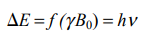
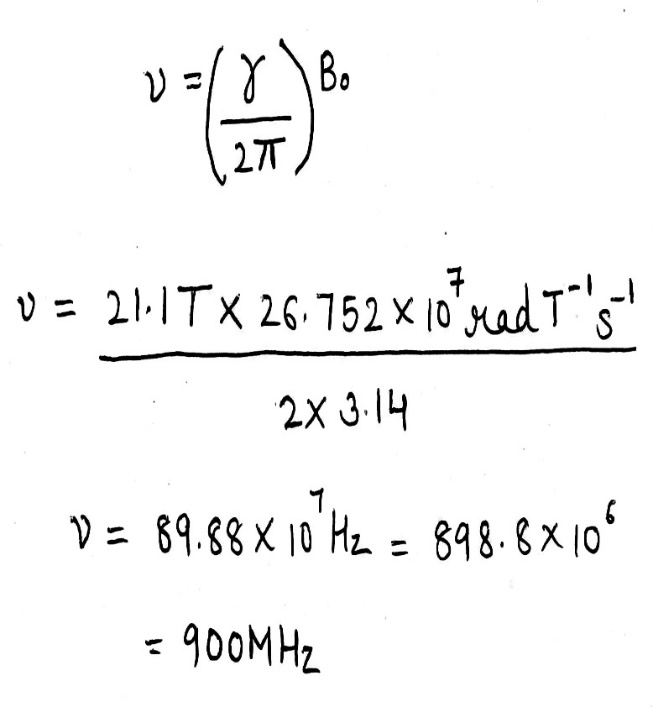
Since the angular momentum of the nucleus is quantized in units of h/2π, the final equation takes the form
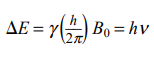

Units:
The SI unit for frequency is the hertz (Hz). One hertz is the same as one cycle per second.
The tesla (symbol: T) is the unit of magnetic field.
SI unit of magnetogyric ratio is the radian per second per tesla (rad⋅s−1⋅T−1)