Correct option is B
A. Radio-immunoassays (RIAs) are more sensitive than Enzyme-linked immunosorbent assays (ELISAs) with chromogenic substrates.
- Correct.
- RIAs use radioisotopes as labels, which offer very high sensitivity and specificity due to low background and high signal-to-noise ratio.
- Chromogenic ELISAs, while easier and safer, are less sensitive than RIAs.
- Hence, this statement is accurate and correct.
B. ELISAs with chromogenic substrates are more sensitive than ELISAs with chemiluminogenic substrates.
- Incorrect.
- Chemiluminescent substrates (used in chemiluminescent ELISAs) are significantly more sensitive than chromogenic substrates due to their enhanced signal intensity and dynamic detection range.
- Hence, this statement is factually incorrect.
C. ELISPOT measures the number of cells capable of secreting particular biomolecules using a substrate that gives soluble product with enzyme reaction.
- Incorrect.
- In ELISPOT assays, the substrate used forms insoluble precipitates, resulting in localized spots at the site of cytokine or biomolecule secretion by individual cells.
- These spots are then counted to estimate secreting cell numbers.
- The statement's mention of "soluble product" is inaccurate, making it incorrect.
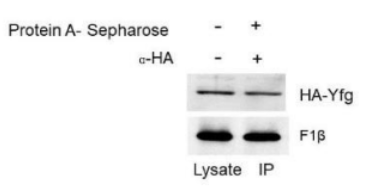
D. In Western blot analysis, the product of enzyme-substrate reaction localizes at the site precisely where the antibody-enzyme conjugate binds to its specific protein band.
- Correct.
- In Western blotting, an enzyme-linked secondary antibody binds to the primary antibody, which recognizes the specific protein.
- The enzyme-substrate reaction occurs only at that site, giving a localized signal corresponding to the protein band.
- This statement is technically accurate.