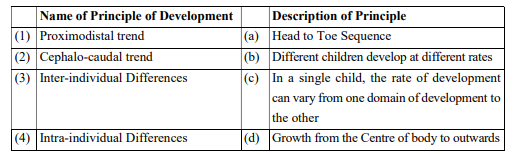
Correct option is B
Contemporary theories of child development emphasize that children are active, purposeful beings who play a significant role in shaping their own growth and development. Rather than being passive recipients of environmental influences or pre-determined by genetics, children actively interact with their environment, make choices, and engage in learning processes that contribute to their physical, cognitive, emotional, and social development.
Theories such as Piaget's cognitive development theory, Vygotsky's socio-cultural theory, and Bronfenbrenner's ecological systems theory highlight the dynamic interplay between the child and their environment. These perspectives underscore that children are not just shaped by external forces but also influence their surroundings through curiosity, exploration, and interaction.
Information Booster
- Active Participants: Contemporary views reject the idea of children as passive recipients, highlighting their role in seeking information and experiences.
- Bi-directional Influences: Development results from interactions between the child’s actions and environmental responses.
- Agency in Learning: Children’s intrinsic motivation drives exploration, problem-solving, and learning.
- Plasticity of Development: While genetics provide a blueprint, experiences, choices, and socio-cultural factors influence outcomes.
- Holistic Approach: Development is multi-faceted, involving cognitive, emotional, physical, and social domains, all influenced by the child’s active participation.
- Adaptation: Children constantly adapt to their environment, reshaping their understanding and behaviors as they grow.
 English
 150 Questions
 150 Marks
 150 Mins