Correct option is A
In the context of scales of measurement,
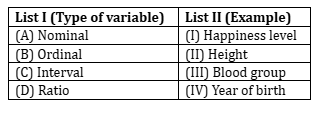
nominal data refers to the categorization of data into discrete groups without any inherent order or ranking. When code numbers are assigned to represent religions (e.g., 1 for Hinduism, 2 for Islam, 3 for Christianity), these numbers merely serve as labels for identification and have no quantitative or sequential significance. Thus, assigning code numbers to religions is an example of nominal measurement.
Nominal scales are used primarily for classification purposes and do not indicate any hierarchical or mathematical relationship among categories.
Information Booster:
1.
Nominal Scale: Used for labeling or naming categories. Examples: gender, religion, nationality.
2.
Ordinal Scale: Indicates order or rank but does not measure differences between ranks. Examples: class positions (1st, 2nd, 3rd).
3.
Interval Scale: Measures differences between data points, with equal intervals but no true zero. Examples: temperature in Celsius or Fahrenheit.
4.
Ratio Scale: Contains all properties of an interval scale, with a true zero point, allowing for meaningful ratios. Examples: weight, height, age.
5.
Religion as Nominal Data: It represents distinct groups without any numerical or ranked significance.
6. Nominal data is analyzed using techniques like mode calculation or chi-square tests.
7. Coding is a common method for simplifying nominal data in statistical analysis.
 English
 10 Questions
 20 Marks
 12 Mins