Correct option is B
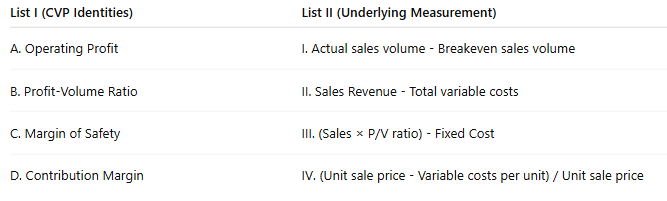
The correct match is:
Operating Profit (A) is the profit after covering fixed costs and variable costs. It is calculated as:
Operating Profit = (Sales × P/V Ratio) - Fixed Cost
Here, the Profit-Volume (P/V) ratio represents the contribution margin ratio. So, Operating Profit corresponds to option III.
Profit-Volume Ratio (B) is the ratio of contribution margin to sales revenue, defined as:

This matches option IV.
Margin of Safety (C) refers to the difference between actual sales volume and the breakeven sales volume, which indicates how much sales can fall before the company incurs a loss. So, Margin of Safety matches option I.
Contribution Margin (D) is the excess of sales revenue over total variable costs:
Contribution Margin = Sales Revenue - Total Variable Costs
This matches option II.
Information Booster:
The Cost-Volume-Profit (CVP) analysis helps management understand the relationships between cost, volume, and profit. Key terms include:
Operating Profit is the profit after variable and fixed costs, indicating the firm's profitability from operations.
Profit-Volume Ratio (P/V ratio) expresses the contribution margin as a percentage of sales, showing how sales affect profit.
Margin of Safety measures the buffer between actual sales and breakeven sales; a higher margin means less risk of loss.
Contribution Margin shows the amount available to cover fixed costs and generate profit after variable costs are deducted.
These identities are foundational in managerial accounting for decision-making, pricing, and budgeting.
 English
 10 Questions
 20 Marks
 12 Mins