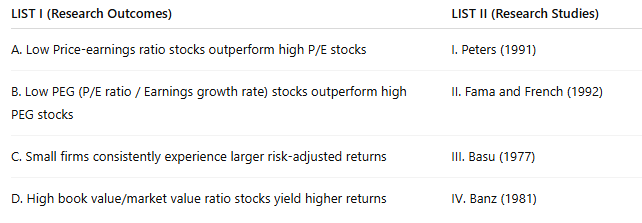
Correct option is B
The correct match is:
A. Low Price-earnings ratio stocks outperform high Price-earnings ratio stocks: This was first documented by Basu (1977) who found that stocks with low P/E ratios generally yield higher average returns. Hence, A matches with III.
B. Low PEG (Price/Earnings to Growth) stocks outperform high PEG stocks: This insight is attributed to Peters (1991) who emphasized the role of PEG ratio (P/E divided by earnings growth rate) in predicting stock performance. Thus, B matches with I.
C. Small firms consistently experience larger risk-adjusted returns: This phenomenon is well known from Banz (1981) who found that small firms outperform larger firms on a risk-adjusted basis. So, C matches with IV.
D. High book value/market value ratio stocks yield higher returns: This is from the seminal work of Fama and French (1992), who identified the value effect through their three-factor model. Thus, D matches with II.
Information Booster:
Basu (1977) highlighted the significance of the P/E ratio in stock performance, showing that low P/E stocks outperform, which challenged the Efficient Market Hypothesis.
Peters (1991) introduced the PEG ratio concept, blending price-to-earnings with growth rate to refine investment decisions.
Banz (1981) documented the “small firm effect,” indicating that smaller companies have historically delivered higher risk-adjusted returns than larger companies.
Fama and French (1992) expanded on the Capital Asset Pricing Model by including size and value factors, especially the book-to-market ratio, to better explain stock returns.
 English
 10 Questions
 20 Marks
 12 Mins