Correct option is C
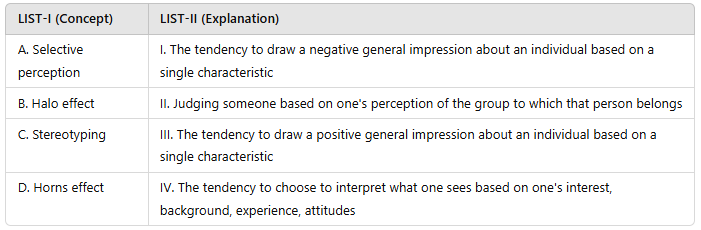
Selective Perception → The tendency to choose to interpret what one sees based on one's interest, background, experience, and attitudes (A - IV)
This occurs when individuals focus on specific aspects of a situation while ignoring others, influenced bypersonal biases, experiences, or pre-existing beliefs.
Example: A manager might perceive a hard-working employee as always competent, even if they make occasional mistakes.
Halo Effect → The tendency to draw a positive general impression about an individual based on a single characteristic (B - III)
If a person excels in one area, people may assume they are also good in other unrelated areas.
Example: If an employee is very punctual, the manager may assume they are also highly productive.
Stereotyping → Judging someone based on one's perception of the group to which that person belongs (C - II)
People assign generalized traits to individuals based on their social, cultural, or demographic background.
Example: Assuming that all engineers are good at mathematics or that women are better at administrative jobs.
Horns Effect → The tendency to draw a negative general impression about an individual based on a single characteristic (D - I)
Opposite of the halo effect, where one negative trait influences the overall perception of a person.
Example: If an employee lacks good communication skills, a manager might assume they are also unskilled in technical tasks.
Information Booster:
Selective Perception
A cognitive bias where individuals see what they want to see.
Affects decision-making, leadership judgments, and workplace behavior.
Halo Effect
A psychological bias leading to unfairly positive evaluations of a person.
Can influence promotions and appraisals in organizations.
Stereotyping
Can lead to discrimination and biased hiring decisions.
HR managers must focus on individual assessments rather than generalizations.
Horns Effect
Often results in unjustified negative perceptions.
Leaders should evaluate performance holistically to avoid bias.
 English
 10 Questions
 20 Marks
 12 Mins