






Correct option is D
It is based on Cattell's 16 Personality Factors (16PF), a model that classifies key traits across bipolar dimensions.
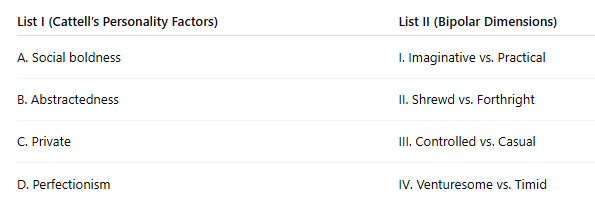
A. Social Boldness – IV. Venturesome vs. Timid
This dimension assesses the extent to which a person is socially daring or shy. Venturesome individuals are bold and assertive, while timid ones are cautious and reserved.B. Abstractedness – I. Imaginative vs. Practical
This factor measures whether a person is imaginative, absent-minded, and idea-driven (imaginative) or more grounded in reality and focused on facts (practical).C. Private – II. Shrewd vs. Forthright
A private person is often discreet, non-transparent, and tends to keep personal matters to themselves, aligning more with shrewd. Forthright individuals are more open.D. Perfectionism – III. Controlled vs. Casual
This factor reflects a tendency toward organization, discipline, and control (controlled) as opposed to a relaxed, spontaneous style (casual).
Information Booster:
The 16 Personality Factor (16PF) theory was developed by Raymond Cattell, a prominent psychologist in the field of trait theory.
Cattell believed personality could be measured along quantifiable bipolar traits using factor analysis.
The 16PF Questionnaire is widely used in clinical psychology, HR assessment, and career counseling.
Each of the 16 primary factors is based on a spectrum between two opposing traits.
The model emphasizes the importance of normal personality traits, not just abnormal ones.
Some factors from 16PF are also used as a foundation for the Big Five Personality Traits, especially in modern personality psychology.
The 16PF includes traits like: Warmth, Reasoning, Emotional Stability, Dominance, Liveliness, Rule-consciousness, Sensitivity, Vigilance, Abstractedness, and more.
 English
 10 Questions
 20 Marks
 12 Mins


