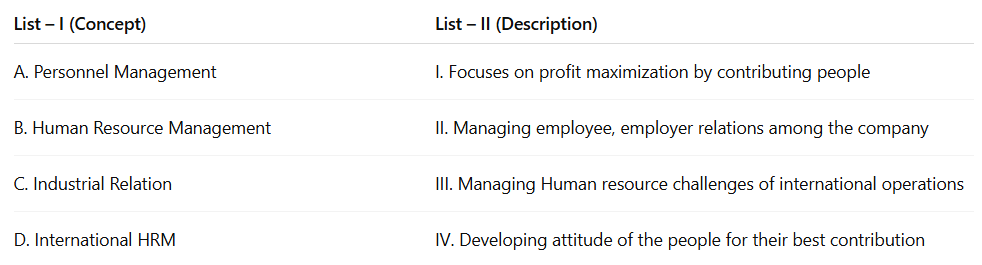
Correct option is D
Behavior Modeling is a structured training approach that focuses on teaching employees desired behaviors through observation and practice. This technique is widely used in corporate training to develop skills, improve interpersonal communication, and enhance performance.
The key components of Behavior Modeling include:
- Modeling: Employees observe and learn from others (typically supervisors or trainers) demonstrating the desired behavior.
- Role-playing: Learners practice the observed behaviors in a controlled environment to reinforce learning.
- Social reinforcement: Positive feedback and encouragement from trainers or peers reinforce the adoption of new behaviors.
- Transfer of training: Employees are encouraged to apply learned behaviors in real work situations.
"Presenting questions, facts, or problems to the learner" does not align with behavior modeling. This technique is more related to traditional instructional methods like lectures, case studies, or problem-solving exercises, rather than experiential learning through observation and practice.
Information Booster:
- Behavior modeling is based on Albert Bandura’s Social Learning Theory, which states that people learn by observing others.
- It is highly effective for developing interpersonal skills, leadership training, and conflict resolution in organizations.
- Many companies use videos, live demonstrations, and simulations to enhance behavior modeling programs.
- Research shows that role-playing combined with feedback significantly improves retention and application of skills.
- The success of behavior modeling depends on reinforcement mechanisms, such as rewards and recognition.
- This method is widely used in customer service, sales training, and team leadership development.
Additional Knowledge:
(a) Modeling
- Involves demonstrating the correct behavior that trainees should adopt.
- Can be performed by supervisors, peers, or through recorded media.
- Helps in learning complex skills through visual and observational learning.
(b) Role-playing
- Employees actively participate and act out scenarios to practice behaviors.
- Helps build confidence, problem-solving, and communication skills.
- Provides a safe environment to make mistakes and learn without real-world consequences.
(c) Social reinforcement
- Uses praise, feedback, and encouragement to reinforce correct behaviors.
- Can be given by managers, peers, or trainers.
- Encourages continuous learning and motivates employees to improve.
 English
 10 Questions
 20 Marks
 12 Mins