
Correct option is A
Introduction:
HRM is the process of acquiring, developing, motivating, and retaining human resources to achieve organizational goals efficiently and effectively.
Simply put, HRM aligns people with the strategic goals of the organization.
Information booster :
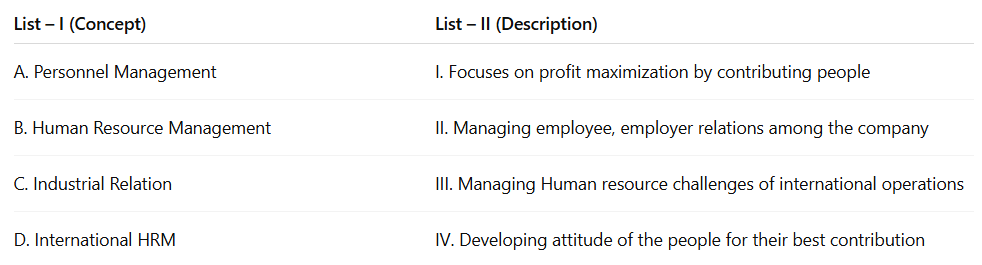
Personnel Management → Traditionally focuses on routine administrative functions, wages, working conditions, and profit maximization via employee contribution → I
Human Resource Management → More modern approach; focuses on developing employees’ attitudes and potential for best contribution → IV
Industrial Relations → Deals with employee-employer relations, trade unions, conflict resolution → II
International HRM → Managing HR in global/international operations → III
Letter | Concept |
|---|---|
(Personnel Management) | Focuses on administration, employee welfare, and discipline; mainly reactive and routine. |
(Human Resource Management) | Focuses on strategic use of human resources, employee development, and alignment with business goals. |
(Industrial Relations) | Deals with employee–employer relations, collective bargaining, and industrial peace. |
(International HRM) | Manages global HR issues like expatriate management, cross-cultural training, and international labor laws. |
Additional information:
Human Resource Management (HRM) performs several key functions that help an organization effectively utilize and develop its human resources. The first function is Human Resource Planning (HRP), which involves forecasting the organization’s manpower needs and ensuring that the right number of people with the right skills are available at the right time. Next is recruitment and selection, where suitable candidates are attracted, screened, and hired to fill job vacancies. HRM also focuses on training and development to enhance employees’ knowledge, skills, and competencies for better performance and future roles. Performance appraisal is conducted to evaluate employees’ work and provide feedback for improvement. Another important function is compensation and rewards management, which ensures fair and motivating pay structures and benefits. HRM also takes care of employee welfare and safety, providing a healthy and secure work environment. Maintaining industrial relations is vital to ensure harmony between management and employees, preventing and resolving conflicts. Moreover, HRM supports career planning and development to help employees grow within the organization, and promotes motivation and engagement to boost morale and productivity. Finally, HRM is responsible for record keeping and legal compliance, ensuring that employee data are accurately maintained and all labor laws are properly followed.
 English
 10 Questions
 20 Marks
 12 Mins


