Correct option is B
Explanation-
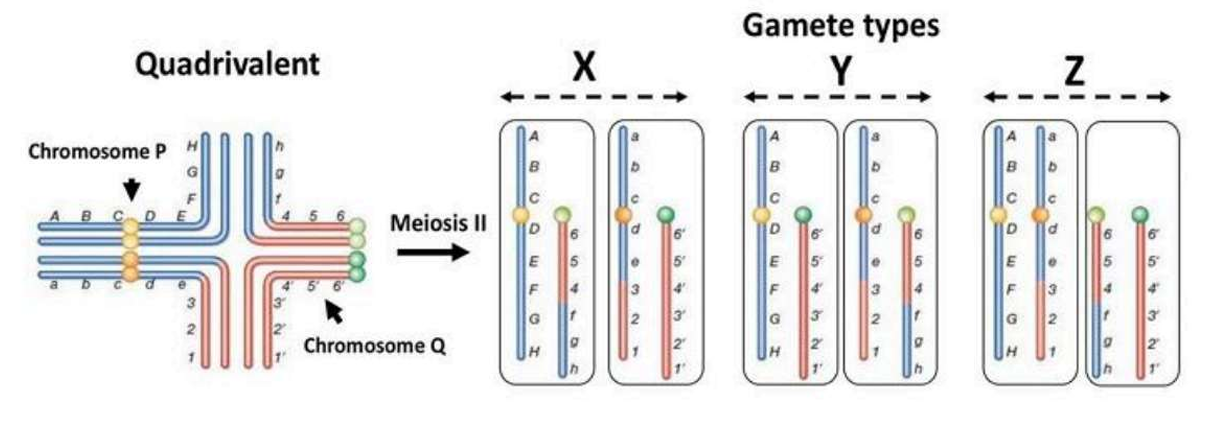
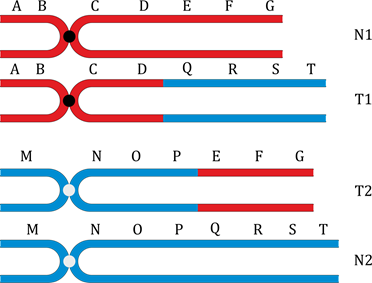
Reciprocal translocation occurs when non-homologous chromosomes exchange segments.
If an individual is heterozygous for this translocation, they have:
1. One normal set of chromosomes (N1 & N2)
2. One translocated set (T1 & T2)
This creates a cross-shaped (quadrivalent) structure during meiosis I due to pairing between homologous regions.
Segregation Types in Meiosis I
There are three types of segregation for reciprocal translocation quadrivalents:
1. Alternate Segregation
N1 + N2 go to one pole, T1 + T2 go to the other. Each gamete gets one complete set of genetic information. This produces viable gametes.
2. Adjacent-1 Segregation
N1 + T2 or T1 + N2 go to one pole. Each gamete gets duplicated and deficient regions. This produces non-viable or inviable gametes.
3. Adjacent-2 Segregation (rare)
Homologous centromeres go to same pole (e.g., N1 + T1 or N2 + T2). This also leads to duplication and deficiency → non-viable.
Statement A -The complexly paired 4 chromosomes fail to segregate, pass into one cell at anaphase I and the cell eventually dies.
Incorrect — This is rare and not typical. Chromosomes do segregate, though not always normally.
Statement B - Chromosomes pair between regions of maximum homology keeping the translocated part unpaired and a normal meiosis occurs.
Incorrect — The chromosomes form a quadrivalent, not unpaired segments, and meiosis can produce abnormal gametes.
Statement C -One of the ways the chromosomes segregate is by alternate segregation (N1, N2 moving to one pole and T1, T2 moving to the other pole).
Correct — This is the alternate segregation, leading to balanced, viable gametes.
Statement D -Alternate segregation produces non-viable gametes.
Incorrect — Alternate segregation produces viable gametes because all genetic material is present.
Statement E - Reciprocal translocations are considered as crossover suppressors as no gametes with crossover product are produced.
Incorrect — Crossovers can still happen, but may result in duplications/deletions. They are not true crossover suppressors.
Correct Answer is option b - C only