arrow
arrow
arrow
In a plant heterozygous for a reciprocal translocation involving chromosome P (ABCDEFGH) and chromosome Q (123456), meiosis I produces a quadrivalent
Question

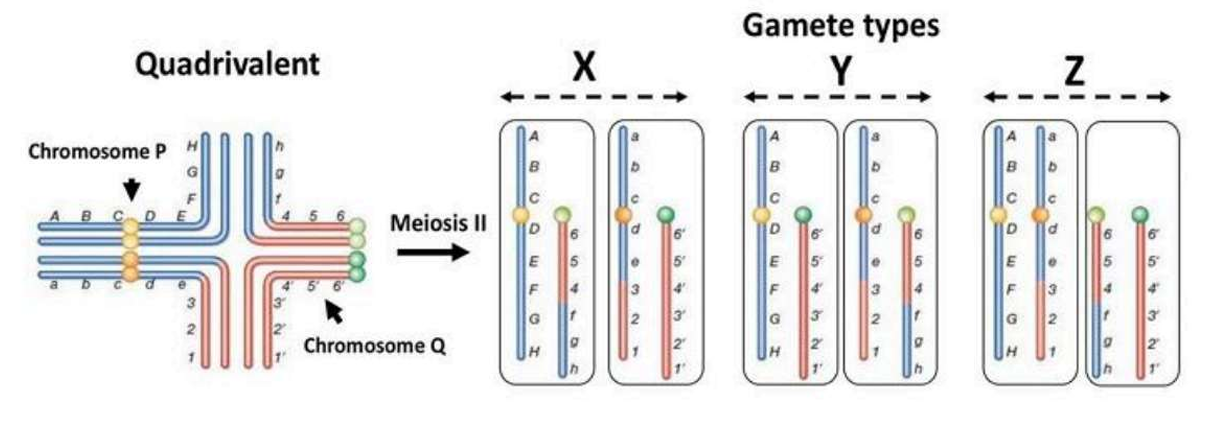
In a plant heterozygous for a reciprocal translocation involving chromosome P (ABCDEFGH) and chromosome Q (123456), meiosis I produces a quadrivalent as shown in the figure, which after meiosis II results in gametes of types labelled X, Y and Z.


Which one of the following combinations correctly represents the segregation pattern of gametes that arise from the quadrivalent configuration as shown in the diagram?

A.

X = Alternate  Y = Adjacent II  Z = Adjacent I

B.

X = Adjacent II Y = Alternate  Z = Adjacent I

C.

X = Adjacent I  Y = Adjacent II Z = Alternate

D.

X = Adjacent I  Y = Alternate  Z = Adjacent II

Correct option is D

Correct Answer:
(d) X = Adjacent I, Y = Alternate, Z = Adjacent II
Explanation:
In reciprocal translocation heterozygotes, quadrivalent segregation can occur in three main ways:
Alternate segregation → balanced gametes (both normal or both translocated chromosomes).
Adjacent I segregation → homologous centromeres go to opposite poles, producing unbalanced gametes.
Adjacent II segregation → homologous centromeres go to the same pole, also producing unbalanced gametes.
From the diagram:
Y shows balanced chromosome complements → Alternate segregation.
X shows adjacent non-homologous centromeres separating → Adjacent I.
Z shows homologous centromeres moving together → Adjacent II.
Information Booster :
· Alternate segregation is the only pattern producing viable, genetically balanced gametes.
· Adjacent I and Adjacent II segregations lead to duplications and deletions.
· Quadrivalent formation is characteristic of reciprocal translocation heterozygotes.
· Fertility reduction in such heterozygotes arises from unbalanced gamete formation.
Additional Information (Incorrect Options):
Options (a), (b), (c): Misassign the balanced gamete group; only alternate segregation yields structurally balanced chromosomes.
Adjacent II segregation is rarer than adjacent I but is clearly depicted for Z in the figure.
Similar Questions

test-prime-package

Access ‘CSIR NET Life Sciences’ Mock Tests with

  • 60000+ Mocks and Previous Year Papers
  • Unlimited Re-Attempts
  • Personalised Report Card
  • 500% Refund on Final Selection
  • Largest Community
students-icon
354k+ students have already unlocked exclusive benefits with Test Prime!
test-prime-package

Access ‘CSIR NET Life Sciences’ Mock Tests with

  • 60000+ Mocks and Previous Year Papers
  • Unlimited Re-Attempts
  • Personalised Report Card
  • 500% Refund on Final Selection
  • Largest Community
students-icon
354k+ students have already unlocked exclusive benefits with Test Prime!
Our Plans
Monthsup-arrow