hamburger menu
All Coursesall course arrow
adda247
reward-icon
adda247
    arrow
    arrow
    arrow
    In T4 phage, a mutation in the rII locus gives rise to large and round plaques, whereas wild-type plaques are small and ragged. Ten independent mutant
    Question

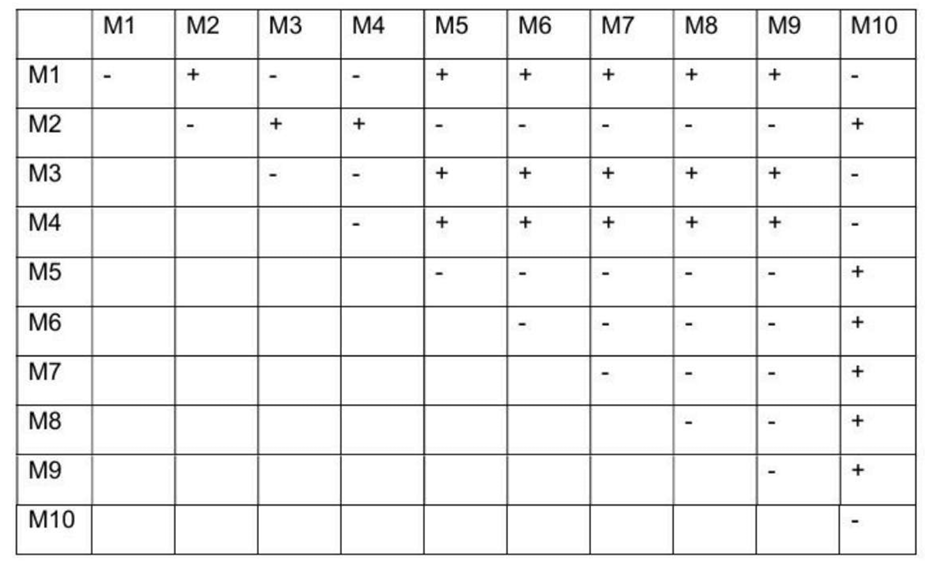
    In T4 phage, a mutation in the rII locus gives rise to large and round plaques, whereas wild-type plaques are small and ragged. Ten independent mutants (M1 to M10) in the rII locus were isolated. To test whether the mutations affected the same protein-coding regions, E. coli cells were co-infected with two mutant phages at a time. The resulting plaques were either wild type (+) or mutant (−). The results for all combinations are shown in the table.


    Based on these observations, the following conclusions were drawn:
    A. The mutants map to two complementation groups.
    B. M1 and M10 are mutations in two different genes.
    C. Each complementation group is represented by 5 mutants.
    Which one of the following options represents a combination of correct statement(s)?

    A.

    A only

    B.

    B only

    C.

    A and B

    D.

    B and C

    Correct option is D

    Correct Answer:
    Option (4) – B and C
    Explanation:
    From the complementation matrix, the mutants clearly fall into two non-complementing sets, indicating two genes within the rII locus (classically rIIA and rIIB). Thus, each set corresponds to a separate gene.
    B is correct: M1 and M10 fall into different non-complementing groups, so they are mutations in different genes.
    C is correct: Each group contains five mutants, consistent with two complementation groups of equal size.
    A is incorrect as stated: While there are two complementation groups, the conclusion was not just their number but also their composition; statement A alone is incomplete relative to the data interpretation required here.
    Information Booster :
    · The rII locus of T4 phage is split into two genes: rIIA and rIIB.
    · Complementation (+ plaques) indicates mutations in different genes.
    · Failure to complement (− plaques) indicates mutations in the same gene.
    · Classical rII mapping experiments were foundational for gene–protein relationships.
    Additional Information (Why other options are incorrect):
    Option 1: Incomplete—does not address mutant distribution across genes.
    Option 2: Incorrect—ignores clear evidence of two equal groups.
    Option 3: Incorrect because statement A alone does not fully capture the correct interpretation, while C is also required.
    Similar Questions

    test-prime-package

    Access ‘CSIR NET Life Sciences’ Mock Tests with

    • 60000+ Mocks and Previous Year Papers
    • Unlimited Re-Attempts
    • Personalised Report Card
    • 500% Refund on Final Selection
    • Largest Community
    students-icon
    354k+ students have already unlocked exclusive benefits with Test Prime!
    test-prime-package

    Access ‘CSIR NET Life Sciences’ Mock Tests with

    • 60000+ Mocks and Previous Year Papers
    • Unlimited Re-Attempts
    • Personalised Report Card
    • 500% Refund on Final Selection
    • Largest Community
    students-icon
    354k+ students have already unlocked exclusive benefits with Test Prime!
    Our Plans
    Monthsup-arrow