Correct option is B
Correct Answer:
Option (2) – A and C
Explanation:
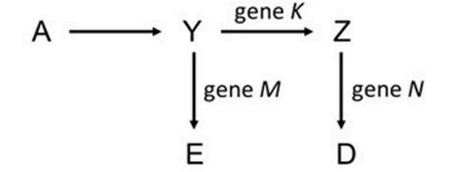
Overexpression of N failing to increase D suggests that flux through the Z → D step is constrained. This can occur if D feedback-inhibits N (A), preventing higher output despite increased enzyme levels.
Alternatively, substrate limitation for N (C) would also block increased D production, as Z availability is governed upstream.
The unchanged levels of E further indicate that flux through gene M is not altered.
Information Booster :
· Metabolic flux is often controlled by substrate availability rather than enzyme abundance.
· Feedback inhibition is a common regulatory mechanism in biosynthetic pathways.
· Overexpression of downstream enzymes rarely increases yield if upstream steps are limiting.
· Pathway engineering requires identifying true rate-limiting steps.
Additional Information (Incorrect Options):
B (Epistasis of N over M): Epistasis does not explain unchanged E levels or lack of D increase.
D (Feedback inhibition of M by E): If active, E levels would differ between transgenic and control plants, which is not observed.
Hence, options including B or D are incorrect.