Correct option is A
Explanation-
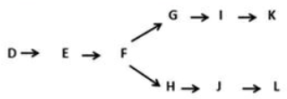
A mechanism where both end products are required to inhibit the first committed step together. Neither K nor L alone can inhibit the pathway; both together do. It's used to ensure balanced production of multiple end products.
Option a - K inhibits F → G and L inhibits F → H; D → E is inhibited at equal amounts of K and L
The branch points are regulated independently by K and L:
K controls its own branch (F → G)
L controls its own branch (F → H)
The common pathway (D → E) is inhibited only when both K and L are present in equal amounts, thus ensuring balanced production.
This independently regulate each branch and stop the common upstream pathway only if both products are sufficient. This mechanism ensures stoichiometric production of K and L.
Incorrect options-
Option b - D → E is inhibited at equal amounts of K and L; K inhibits F → H and L inhibits F → G
This reverses logical feedback:
K should inhibit F → G, but here it inhibits F → H.
L should inhibit F → H, but here it inhibits F → G.
This can cause overproduction of K when L is high, overproduction of L when K is high
Although concerted inhibition of D → E is correct, wrong feedback at branches breaks stoichiometric balance.
Option c - D → E is inhibited at equal amounts of G and H; K inhibits F → H and L inhibits F → G
Feedback from intermediates (G and H) instead of final products (K and L) — not typical in feedback inhibition. K and L inhibit the wrong branches again. Feedback should come from end products, not intermediates.
Option d - K inhibits F → H and L inhibits F → G
No inhibition at the common step (D → E) at all — no concerted control. Also, K and L are inhibiting wrong branches again. This would result in high K causing low L, and vice versa → imbalance. Hence violates the principle of concerted feedback inhibition.
So, the correct answer is option a : K inhibits F → G and L inhibits F → H; D → E is inhibited at equal amounts of K and L