
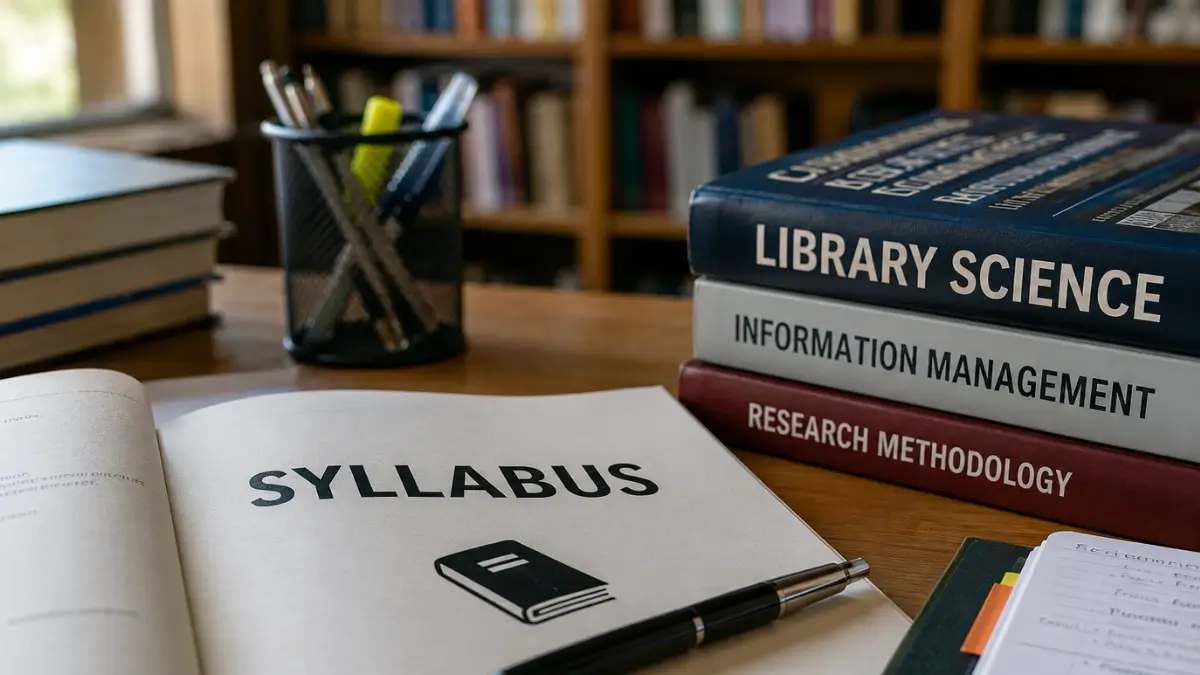
The Bihar Librarian Syllabus 2026 covers important subjects such as Library and Information Science, General Knowledge and Current Affairs, Reasoning and Analytical Ability, and Computer Awareness. Going through the syllabus beforehand allows candidates to identify the major topics and plan their exam preparation in a systematic manner.
The Bihar Librarian examination will be held in objective-type format with 100 questions carrying a total of 100 marks. Candidates will have 2 hours to complete the written test. The sections below provide details of the subject-wise syllabus, exam pattern, key topics, important areas for preparation, and helpful preparation strategies.
Bihar Librarian Syllabus 2026 Overview
Before starting their preparation, candidates should first understand the key details of the Bihar Librarian examination, including the conducting authority, exam mode, number of questions, marks, duration, and subjects. The table below provides a quick overview of the Bihar Librarian Syllabus 2026 and examination structure.
Must Read: Bihar Librarian Vacancy 2026
Bihar Librarian Exam Pattern 2026
The Bihar Librarian Exam Pattern 2026 gives candidates a clear idea of the question format, total marks, exam duration, and subjects covered in the written examination. Understanding the exam structure helps candidates plan their preparation and manage their time effectively during the exam.
| Subject | Questions | Marks | Duration |
|---|---|---|---|
| Library & Information Science | 100 | 100 | 2 Hours |
| General Awareness & Current Affairs | |||
| Reasoning & Analytical Ability | |||
| Computer Awareness | |||
| Total | 100 | 2 Hours |
Bihar Librarian Syllabus 2026
The Bihar Librarian Syllabus 2026 is divided into four major sections: Library and Information Science, General Awareness & Current Affairs, Reasoning & Analytical Ability, and Computer Awareness. The detailed subject-wise syllabus is given below.
Library and Information Science Syllabus
| Topic | Important Areas |
|---|---|
| Foundation and Organisation of Library | Functions and objectives of libraries, types of libraries, role of libraries as social and educational institutions |
| Library Management | Circulation, stock verification, weeding, budgeting, accounting, collection development |
| Classification | DDC, UDC, Colon Classification |
| Cataloguing | AACR2, RDA and cataloguing principles |
| Reference and Information Services | Reference services, information literacy, user education, document delivery, inter-library loan |
| Reference Sources | Encyclopedias, dictionaries, directories, biographical sources |
| Library Automation | Digital libraries, e-resources, internet, databases, barcode and RFID |
| Library Software | SOUL, KOHA, e-Granthalaya |
| Library Networks | INFLIBNET, DELNET, OCLC and resource sharing |
| Research Methods | Quantitative and qualitative research, information search techniques |
| Bibliometrics | Bibliometrics, webmetrics and related concepts |
| Library Associations | ILA, IASLIC, IFLA, ALA |
| Library Standards | ISBN, ISSN, MARC |
| Legal and Ethical Issues | Copyright, intellectual property rights and professional ethics |
General Awareness and Current Affairs Syllabus
| Topic | Sub-Topics |
|---|---|
| Current Affairs | National and international current events, important recent developments |
| Indian History | Ancient, medieval and modern Indian history; freedom movement |
| Indian Geography | Physical features, rivers, climate, agriculture, minerals and resources |
| Indian Polity | Constitution, fundamental rights and duties, Parliament, President, Prime Minister, judiciary and important constitutional provisions |
| Indian Economy | Basic economic concepts, banking, budget, taxation, inflation and major economic developments |
| Indian Culture | Art, literature, dance, music, festivals, monuments and cultural heritage |
| Science and Technology | Basic science, space, information technology, inventions and recent developments |
| Bihar General Knowledge | History, geography, culture, important personalities, rivers, economy and major developments of Bihar |
| Awards and Honours | National and international awards, important prizes and honours |
| Government Schemes | Major government schemes, programmes, initiatives and policies |
Reasoning and Analytical Ability Syllabus
| Topic | Sub-Topics |
|---|---|
| Analogy | Verbal and number-based analogies |
| Series | Number series, alphabet series and mixed series |
| Coding-Decoding | Letter coding, number coding and pattern-based coding |
| Blood Relations | Family relationships and relationship-based problems |
| Syllogism | Statements, conclusions and logical deductions |
| Venn Diagram | Set-based problems and logical relationships |
| Classification | Classification of words, numbers, letters and figures |
| Direction Sense | Direction, distance and position-based questions |
| Puzzles | Seating arrangement, ranking and logical puzzles |
| Data Interpretation | Tables, charts, graphs and basic data-based questions |
| Logical Reasoning | Statement and conclusion, statement and assumption, cause and effect |
| Verbal Reasoning | Logical sequence, decision-making and analytical questions |
| Non-Verbal Reasoning | Figure classification, mirror images, water images, paper folding and figure series |
Computer Awareness Syllabus
| Topic | Sub-Topics |
|---|---|
| Computer Fundamentals | Characteristics, generations, types and basic concepts of computers |
| Computer Hardware | CPU, motherboard, memory, storage devices and other hardware components |
| Input and Output Devices | Keyboard, mouse, scanner, printer, monitor and other input/output devices |
| Computer Software | System software, application software and utility software |
| Operating Systems | Basic concepts and functions of operating systems; Windows and Linux |
| Memory and Storage | RAM, ROM, cache memory, hard disk, SSD and other storage devices |
| MS Office | MS Word, MS Excel and MS PowerPoint; basic functions and features |
| Internet | Web browsers, search engines, websites, URLs and basic internet concepts |
| Email features, attachments, sending and receiving messages | |
| Computer Networks | LAN, WAN, network basics, routers, switches and modems |
| Database Basics | Basic database concepts, data organisation and database management |
| Cyber Security | Malware, viruses, phishing, passwords, data security and online safety |
| Digital Technology | Basic concepts of digital information, online services and information technology |
Bihar Librarian 2026: Important Topics
- Library Science: Classification, Cataloguing, Library Management, Reference Services, Library Automation and Digital Libraries.
- General Awareness: Current Affairs, Indian History, Geography, Polity, Economy and Bihar GK.
- Reasoning: Series, Analogy, Coding-Decoding, Blood Relations, Syllogism and Puzzles.
- Computer Awareness: Computer Basics, MS Office, Internet, Networking and Cyber Security.
Bihar Librarian 2026 Preparation Tips
- Prioritise Library Science: Build strong concepts in classification, cataloguing, library management and information services.
- Make short notes: Prepare quick revision notes for important terms, standards, organisations and library software.
- Practise Reasoning: Solve different types of reasoning questions regularly to improve speed.
- Revise Current Affairs: Cover important national, international and Bihar-related developments.
- Strengthen Computer Basics: Focus on MS Office, operating systems, internet, networking and cyber security.
- Attempt mock tests: Practise full-length tests within the prescribed time limit.
- Revise regularly: Keep separate revision slots for difficult Library Science topics and factual information.
| Also Check |
| Bihar Librarian Previous Year Question Papers |


 APPSC Technical Assistant Syllabus And E...
 Punjab Court Clerk Syllabus And Exam Pat...
 KEA VAO Syllabus 2026: Check Exam Patter...
 Adda247 Job portal has complete information about all Sarkari Jobs and Naukri Alerts, its latest recruitment notifications, from all state and national level jobs and their updates.