
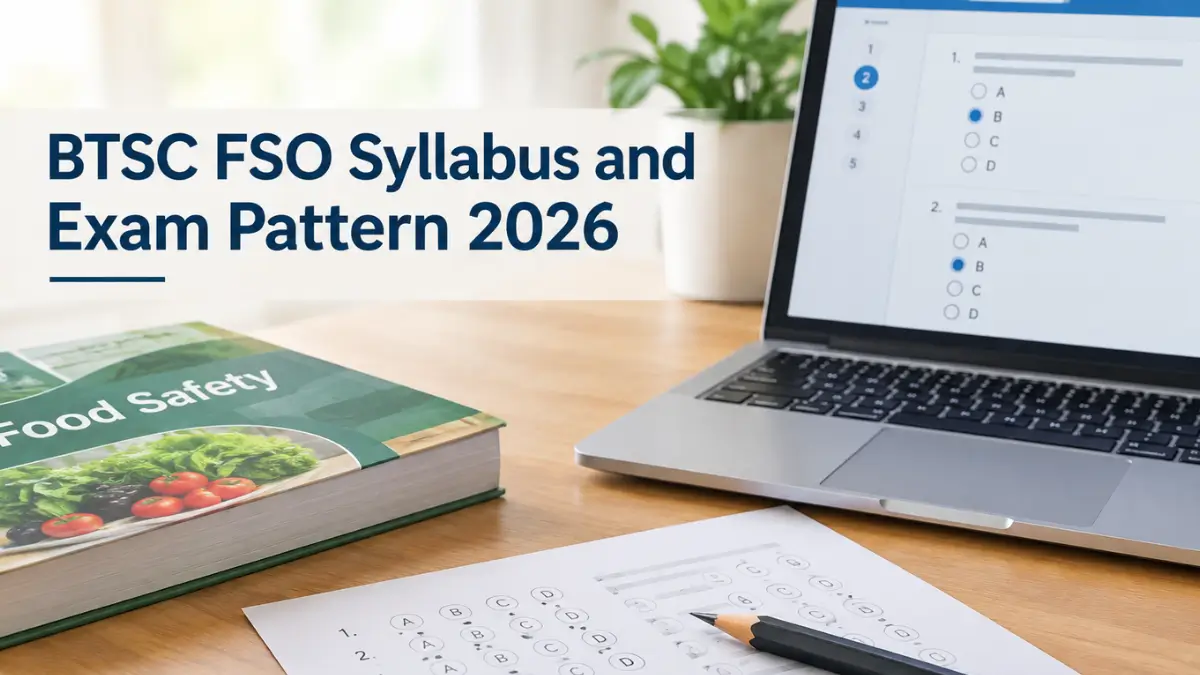
The Bihar Technical Service Commission (BTSC) has published the official Food Safety Officer (FSO) Syllabus 2026 for candidates preparing for the recruitment examination. Candidates can check the complete syllabus, including General Studies, Mental Ability, Food Chemistry, Food Microbiology and Food Processing Technology, through the official syllabus PDF.
BTSC FSO Syllabus 2026 Overview
Candidates can check the key details of the Bihar Food Safety Officer syllabus and examination structure below.
| Particulars | Details |
|---|---|
| Exam Name | BTSC Food Safety Officer Exam 2026 |
| Conducting Body | Bihar Technical Service Commission |
| Post | Food Safety Officer |
| Exam Mode | Computer-Based Test (CBT) |
| Question Type | Multiple Choice Questions |
| Total Questions | 100 |
| Maximum Marks | 100 |
| Exam Duration | 2 Hours |
| Negative Marking | 0.25 marks for each wrong answer |
| Question Paper Language | Hindi and English |
| Selection Basis | Written Competitive Examination |
Must Check: Bihar BTSC FSO Vacancy 2026
BTSC FSO Exam Pattern 2026
The BTSC Food Safety Officer examination consists of two sections with a combined weightage of 100 marks. The first section covers General Studies and Mental Ability, while the second section focuses on Chemistry and Food Nutrition. The official syllabus specifies a total examination duration of 2 hours.
| Subject | Total Marks |
| General Studies and Mental Ability | 25 |
| Chemistry and Food Nutrition | 75 |
| 100 |
BTSC FSO Syllabus 2026
The official BTSC FSO syllabus is divided into two papers. Paper 1 includes General Studies and Mental Ability, while Paper 2 covers three technical subjects: Food Chemistry, Food Microbiology and Food Processing Technology. The detailed topics are explained below.
Paper 1: General Studies and Mental Ability
The important topics are:
- Events of national and international importance.
- Current affairs – international, national and regional.
- General Science and its applications in day-to-day life.
- Contemporary developments in Science, Technology and Information Technology.
- Social, economic and political history of modern India.
- Indian polity and governance, constitutional issues, public reforms and e-governance initiatives.
- Economic development in India since independence.
- Physical geography of the Indian subcontinent and Bihar.
- Disaster management, vulnerability profile, prevention and mitigation strategies.
- Application of Remote Sensing and GIS in disaster assessment.
- Sustainable development and environmental protection.
- Logical reasoning and analytical ability.
- Data interpretation and data analysis.
- Tabulation of data.
- Basic statistical analysis, including mean, median, mode, variance and coefficient of variation.
Paper 2: Chemistry and Food Nutrition
Paper 2 carries 75 marks and is divided into three major subjects. Candidates should carefully study all the technical topics mentioned in the official syllabus.
1. Food Chemistry
The important topics include:
- Carbohydrates: Structure and functional properties of monosaccharides, disaccharides, oligosaccharides and polysaccharides.
- Starch, cellulose, pectic substances and dietary fibre.
- Proteins: Classification and structure of food proteins.
- Lipids: Classification and structure of lipids.
- Rancidity of fats.
- Polymerisation and polymorphism.
- Food pigments, including carotenoids, chlorophylls, anthocyanins, tannins and myoglobin.
- Food flavours, including terpenes, esters, ketones and quinones.
- Enzymes.
- Enzymatic and non-enzymatic browning in different foods.
2. Food Microbiology
Candidates should prepare the following topics:
- Characteristics of microorganisms.
- Morphology, structure and detection of bacteria, yeast and mould in food.
- Spores and vegetative cells.
- Microbial growth in food.
- Intrinsic and extrinsic factors affecting microbial growth.
- Growth and death kinetics.
- Serial dilution method for quantification.
- Factors contributing to food spoilage.
- Spoilage-causing bacteria.
- Microbial spoilage of milk, milk products, meat and meat products.
- Food-borne diseases and toxins produced by Staphylococcus, Clostridium and Aspergillus.
- Bacterial pathogens, including Salmonella, Bacillus, Listeria, Escherichia coli, Shigella and Campylobacter.
- Natural food hazards, including seafood toxins, biogenic amines, alkaloids, phenolic compounds, protease inhibitors and phytates.
- Types of food hazards: Biological, chemical and physical.
- Factors affecting food safety.
- Importance of safe food.
- General methods of food preservation and food processing.
3. Food Processing Technology
The major topics are:
| Food Category |
Important Topics
|
| Cereals |
Rice milling, parboiling, barley pearling, malting and brewing
|
| Corn and Wheat |
Wet and dry milling of corn, wheat milling
|
| Pulses |
Milling, germination, cooking, roasting, frying, canning and fermentation
|
| Oilseeds |
Extraction and refining
|
| Fruits |
Fruit processing, Individual Quick Freezing (IQF) and thawing
|
| Plantation Crops |
Primary and secondary processing of tea, coffee and cocoa
|
| Spices |
Oleoresin and essential oil extraction
|
| Meat, Fish and Poultry |
Ante-mortem inspection, slaughtering, dressing, post-mortem examination, canning, curing, smoking, freezing and dehydration
|
| Milk |
Receiving, separation, clarification, pasteurisation, standardisation, homogenisation, sterilisation and UHT processing
|
Other important topics under Food Processing Technology include:
- Unit operations of food processing.
- Grading and sorting.
- Peeling and size reduction.
- Consumer trends and their impact on new product development.
- Stages of product development, including idea generation and evaluation.
- Developing ideas into products.
- Test marketing and commercialisation.
- Criteria for selection of raw materials.
- Sensory evaluation.
- Objective evaluation and standardisation.
BTSC FSO Syllabus PDF 2026 Download
Candidates can download the official BTSC Food Safety Officer syllabus PDF to check the complete subject-wise topics and examination structure. For the convenience of the candidates we have provide a direct link to download the pdf below:
BTSC FSO Preparation Tips 2026
Candidates preparing for the BTSC FSO Exam 2026 should follow a focused study plan covering the general and technical sections. Regular revision, MCQ practice and mock tests can help improve accuracy and time management.
- Cover the complete syllabus and divide time between general and technical subjects.
- Focus more on Food Safety, Microbiology, Hygiene, Processing and Food Analysis.
- Practise topic-wise MCQs and previous questions regularly.
- Revise important concepts and facts frequently.
- Avoid unnecessary guessing due to 0.25-mark negative marking.
- Keep track of the latest BTSC exam-related updates and notices.





 Gujarat Police Constable Syllabus & ...
 KPSC FDA SDA Syllabus and Exam Pattern 2...
 HP Patwari Syllabus 2026, Check Exam Pat...



 Adda247 Job portal has complete information about all Sarkari Jobs and Naukri Alerts, its latest recruitment notifications, from all state and national level jobs and their updates.