Table of Contents
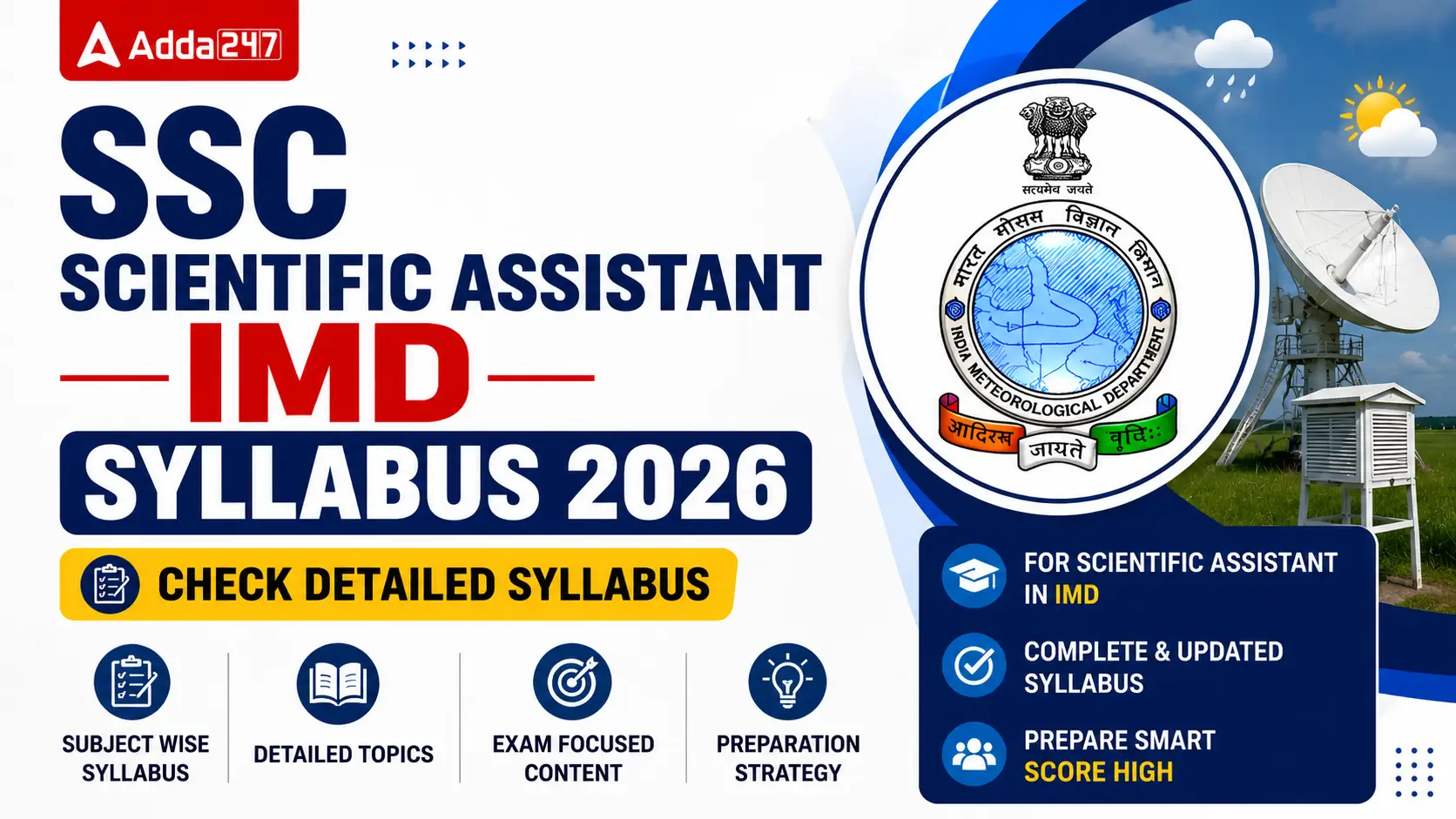
SSC Scientific Assistant IMD Syllabus 2026 has been released by the Staff Selection Commission along with the SSC JE Examination 2026 notification. Candidates preparing for the Scientific Assistant in India Meteorological Department (IMD) post should carefully check the syllabus before starting their preparation. The SSC Scientific Assistant IMD syllabus is divided into Part-D, Part-E and Part-F. Candidates have to choose one subject according to their educational qualification: Computer Science & Information Technology, Electronics & Telecommunication Engineering, or Physics.
SSC Scientific Assistant IMD Syllabus 2026 – Overview
The SSC Scientific Assistant IMD examination has two papers. General Intelligence & Reasoning and General Awareness are compulsory in Paper-I. In addition, candidates have to attempt the subject selected in the application form.
| Particulars | Details |
|---|---|
| Exam Name | SSC Junior Engineer Examination 2026 |
| Post | Scientific Assistant in IMD |
| Conducting Body | Staff Selection Commission (SSC) |
| Exam Mode | Computer-Based Examination |
| Selection Stages | Paper-I and Paper-II |
| Paper-I | 200 Questions, 200 Marks |
| Paper-II | 100 Questions, 300 Marks |
| Subject for IMD | Part-D / Part-E / Part-F |
| Part-D | Computer Science & Information Technology |
| Part-E | Electronics & Telecommunication Engineering |
| Part-F | Physics |
| Question Type | Objective Multiple Choice Questions |
| Negative Marking | 0.25 marks in Paper-I and 1 mark in Paper-II |
| Paper-I Duration | 2 Hours |
| Paper-II Duration | 2 Hours |
SSC Scientific Assistant IMD Paper-I Syllabus 2026
Paper-I consists of three sections:
| Subject | Questions | Marks |
|---|---|---|
| General Intelligence & Reasoning | 50 | 50 |
| General Awareness | 50 | 50 |
| Part-D / Part-E / Part-F | 100 | 100 |
| Total | 200 | 200 |
General Intelligence & Reasoning
The questions will include both verbal and non-verbal reasoning. Important topics include:
- Analogy
- Similarities and Differences
- Space Visualization
- Problem Solving
- Analysis
- Judgment
- Decision Making
- Visual Memory
- Observation
- Relationship Concepts
- Arithmetical Reasoning
- Verbal and Figure Classification
- Number Series
- Abstract Ideas and Symbols
- Analytical Functions
General Awareness
General Awareness questions will cover:
- Current Affairs
- History
- Culture
- Geography
- Economic Scene
- General Polity
- Scientific Research
- India and its neighbouring countries
- Everyday scientific observations
The General Awareness section does not require specialised study of any particular discipline.
SSC Scientific Assistant IMD Subject-Wise Syllabus 2026
Candidates applying for Scientific Assistant in IMD have to select one of three subjects based on their educational qualification. The selected subject cannot be changed later.
Part-D: Computer Science & Information Technology
The official syllabus covers these topics at approximately the graduation level for Computer Science & Information Technology.
| Subject | Important Topics |
|---|---|
| Engineering Mathematics | Discrete Mathematics, Linear Algebra, Calculus, Probability and Statistics |
| Digital Logic | Boolean Algebra, Combinational and Sequential Circuits, Minimization, Number Systems |
| Computer Organization | Machine Instructions, Addressing Modes, ALU, Control Unit, Pipelining, Memory Hierarchy, I/O |
| Programming & Data Structures | C Programming, Recursion, Arrays, Stacks, Queues, Linked Lists, Trees, Graphs |
| Algorithms | Searching, Sorting, Hashing, Complexity, Greedy Method, Dynamic Programming, Divide and Conquer |
| Theory of Computation | Regular Expressions, Finite Automata, CFG, PDA, Turing Machines, Undecidability |
| Compiler Design | Lexical Analysis, Parsing, Syntax-Directed Translation, Code Generation, Optimization |
| Operating System | Processes, Threads, Synchronization, Deadlock, Scheduling, Memory Management, File Systems |
| Databases | ER Model, Relational Model, SQL, Normalization, Indexing, Transactions |
| Computer Networks | OSI, TCP/IP, Routing, IP Addressing, ARP, DHCP, ICMP, TCP, UDP, DNS, HTTP, FTP |
Part-E: Electronics & Telecommunication Engineering
The Electronics and Telecommunication syllabus includes detailed topics from basic electronics, communication systems, antennas and wireless communication.
| Subject | Important Topics |
|---|---|
| Electronic Materials & Components | Conductors, Semiconductors, Insulators, Magnetic and Passive Components |
| Diodes | PN Junction, Zener Diode, Rectifiers, Clippers, Clampers |
| Transistors | BJT, FET, MOSFET, Biasing, Transistor as Switch |
| Amplifiers & Oscillators | Multistage Amplifiers, Feedback, Oscillators, Multivibrators, Power Amplifiers |
| Network Theorems | Kirchhoff’s Laws, Superposition, Thevenin, Norton, Maximum Power Transfer |
| AC Circuits | RL, RC and RLC Circuits, Reactance, Impedance, Admittance |
| Three-Phase Circuits | Star and Delta Connections |
| Resonance | Series and Parallel Resonance, Q Factor, Bandwidth |
| Digital Electronics | Logic Gates, Boolean Algebra, Digital Logic |
| Sequential & Combinational Logic | Flip-Flops, Counters, Shift Registers |
| Data Conversion | ADC, DAC and Timing Circuits |
| Antennas | Directivity, Radiation Pattern, Yagi and Parabolic Antennas |
| Radio Wave Propagation | Ground Wave, Space Wave, Ionospheric Propagation |
| Modulation | AM, SSB, FM, PM, Modulation Index |
| Pulse Modulation | PAM, PWM, PPM, PCM, Delta Modulation |
| Multiplexing | FDM and TDM |
| Digital Communication | ASK, PSK, FSK, Fibre Optics |
| Wireless Communication | HF, VHF, UHF, Microwave and Satellite Communication |
Part-F: Physics
The official SSC syllabus specifies the Physics paper at approximately the graduation level.
| Subject | Important Topics |
|---|---|
| Mathematical Methods | Calculus, Differential Equations, Fourier Series, Vector Algebra, Linear Algebra, Complex Numbers, Statistics and Error Analysis |
| Mechanics | Newton’s Laws, Kinematics, Central Force, Kepler’s Laws, Conservation Laws, Rigid Body Dynamics |
| General Properties of Matter | Elasticity, Surface Tension, Viscosity, Fluid Dynamics, Bernoulli’s Theorem |
| Oscillations | Simple Harmonic Motion, Damped and Forced Oscillations, Resonance, Quality Factor |
| Waves | Wave Equation, Standing Waves, Sound Waves, Doppler Effect, Group and Phase Velocity |
| Optics | Reflection, Refraction, Interference, Diffraction, Polarization, Optical Instruments |
| Electricity | Electric Field, Potential, Gauss’s Law, Capacitance, DC and AC Circuits |
| Magnetism | Magnetic Field, Ampere’s Law, Faraday’s Law, Maxwell’s Equations, EM Waves |
| Kinetic Theory | Ideal Gas, Temperature, Specific Heat, Maxwell Distribution, Mean Free Path |
| Thermodynamics | Laws of Thermodynamics, Entropy, Carnot Cycle, Heat Engines, Thermodynamic Relations |
| Modern Physics | Relativity, Photoelectric Effect, Compton Effect, de Broglie Waves, Uncertainty Principle, Quantum Mechanics |
| Solid State Physics | Crystal Structure, Bravais Lattices, Miller Indices, X-Ray Diffraction, Band Theory, Semiconductors |
| Semiconductor Devices | PN Junction, Zener Diode, Rectifiers, BJT and Transistor Characteristics |
| Analog & Digital Electronics | Amplifiers, Oscillators, OP-AMP, Boolean Algebra, Logic Gates and Number Systems |
SSC Scientific Assistant IMD Paper-II Syllabus 2026
Paper-II is also based on the subject selected by the candidate during the application process. Paper-II contains 100 questions for 300 marks and has a duration of 2 hours. Candidates must attempt the same subject that they selected for the application form.
| Post | Paper-II Subject |
|---|---|
| Scientific Assistant IMD | Part-D Computer Science & Information Technology |
| Scientific Assistant IMD | Part-E Electronics & Telecommunication Engineering |
| Scientific Assistant IMD | Part-F Physics |
SSC Scientific Assistant IMD Exam Pattern 2026
| Paper | Subject | Questions | Marks | Duration |
|---|---|---|---|---|
| Paper-I | General Intelligence & Reasoning | 50 | 50 | 2 Hours |
| Paper-I | General Awareness | 50 | 50 | 2 Hours |
| Paper-I | Part-D/E/F | 100 | 100 | 2 Hours |
| Paper-I Total | — | 200 | 200 | 2 Hours |
| Paper-II | Part-D/E/F | 100 | 300 | 2 Hours |
SSC IMD Negative Marking 2026
There is negative marking in both papers. Both Paper-I and Paper-II contain objective-type multiple-choice questions. The questions are set in Hindi and English, except where otherwise applicable
| Paper | Negative Marking |
|---|---|
| Paper-I | 0.25 marks for each wrong answer |
| Paper-II | 1 mark for each wrong answer |
How to Prepare for SSC Scientific Assistant IMD 2026?
Candidates should first identify their selected subject and complete the syllabus topic by topic.
- Start with basic concepts and formulas.
- Make short notes for important topics.
- Solve previous year questions regularly.
- Practice numerical questions for Physics and technical subjects.
- Give special attention to Computer Science concepts and programming.
- Revise Electronics and Communication formulas frequently.
- Read current affairs for the General Awareness section.
- Take regular mock tests.
- Analyse mistakes after every mock test.
- Avoid random guessing because of negative marking.


 SECL Result 2026 Out, Download Scorecard...
 BCPL Recruitment 2026 Notification Out, ...
 RRB JE Apply Online 2026 Ends Soon, Chec...