Table of Contents
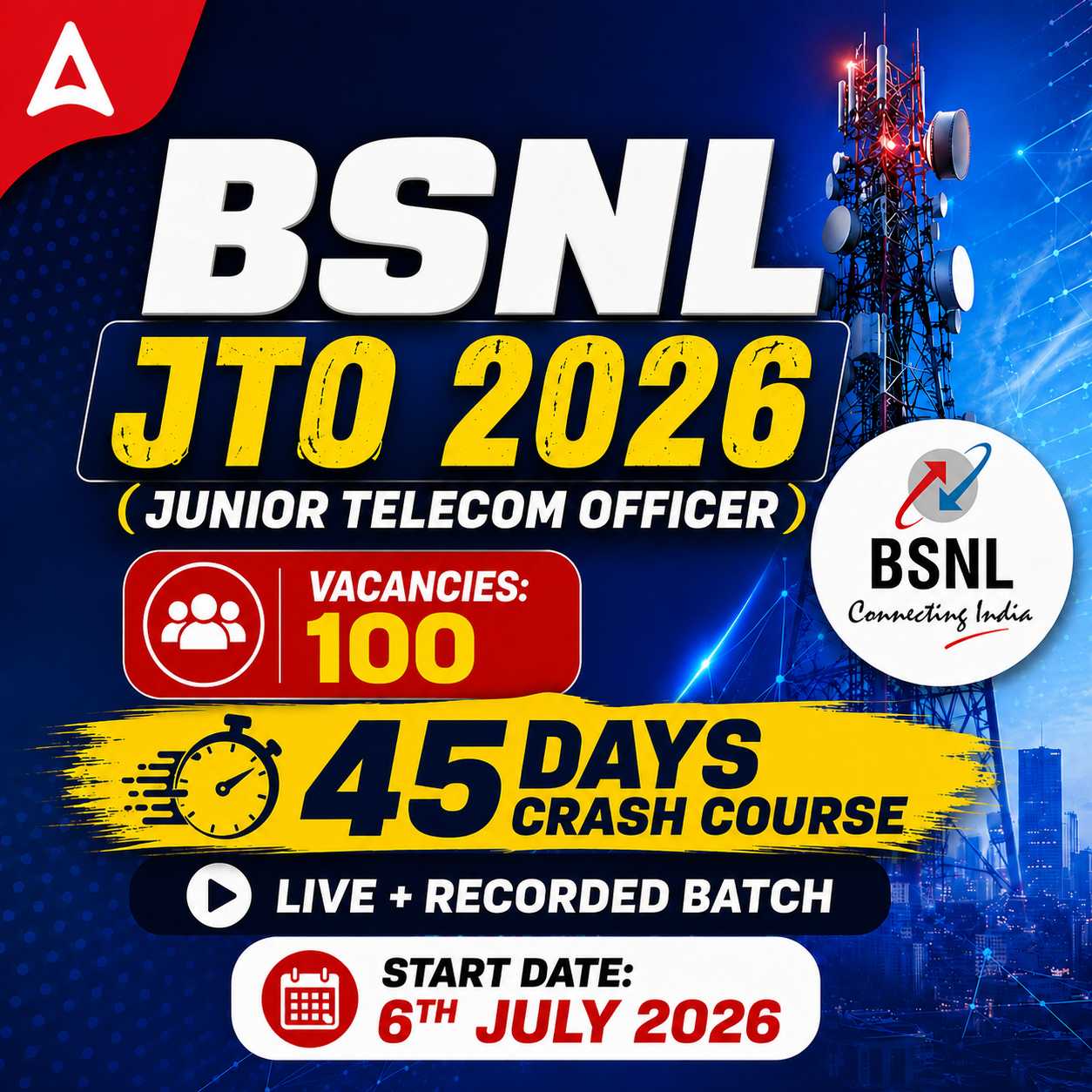
With the BSNL JTO Exam 2026 now scheduled, candidates should focus on completing their syllabus revision and strengthening their preparation. Regularly solving previous year question papers and attempting mock tests will help improve accuracy, speed, and overall exam performance. The BSNL JTO Syllabus 2026 covers three major sections: Engineering Subjects, General Aptitude, and General Ability. A well-planned preparation strategy and consistent practice will increase the chances of scoring well in the examination.
Candidates are advised to follow the latest exam pattern and prepare each section according to its weightage. Posts on its website at bsnl.co.in. Interested candidates applying for these posts should check the BSNL JTO Syllabus 2026. This article explains the detailed topic-wise syllabus & exam pattern. Candidates should read this article for all important details regarding the exam syllabus & pattern.
BSNL Syllabus 2026: Overview
The candidates must refer to the table below to check the key details regarding the BSNL 2026 Syllabus:
| BSNL JTO Syllabus 2026: Summary | |
| Organization | Bharat Sanchar Nigam Limited (BSNL) |
| Exam Type | Computer-Based Test (MCQ) |
| Total Sections | 3 Section |
| Total Question | 120 Question |
| Total Marks | 480 Marks |
| Negative Marking | 1 Marks |
| Join Our Telegram Channel for Latest Updates | |
BSNL JTO Exam Pattern 2026
The BSNL JTO Exam Pattern 2026 consists of three sections. The CBT exam will contain a total of 120 questions carrying 480 marks. Candidates will get 3 hours to complete the exam, and 1 mark will be deducted for a wrong answer. Candidates can review the BSNL Exam Pattern Table to understand it.
| Part | Particulars | Number of Questions | Marks | Negative Marking | Duration |
| Part I | Engineering Stream – I | 50 Questions | 200 Marks | 01 | 3 Hours (Total Exam) |
| Part II | Engineering Stream – II | 50 Questions | 200 Marks | ||
| Part III | General Ability Test | 20 Questions | 80 Marks | ||
| Total | 120 Questions | 480 Marks | 3 Hours | ||
Download BSNL JTO Admit Card 2026 – Click Here
Minimum Qualification Marks
| Category | Minimum Qualifying Marks | |
| Each Section | Overall | |
| UR/OBC(CL) | 40% | 50% |
| SC/ST/OBC (NCL)/PwBD/EWS | 35% | 45% |
BSNL JTO Syllabus 2026
Bharat Sanchar Nigam Limited will conduct the Computer-Based Test for selecting candidates for various positions. The aspirants should check the Syllabus and prepare for every topic rigorously. Below is an in-depth breakdown of the syllabus outlining the specific subjects and key topics candidates should focus on in preparation for the examination.
Engineering Stream I Syllabus
| Subject | Topics |
| Materials and Components | Structure and properties of electronic engineering materials; conductors, semiconductors, and insulators; magnetic, ferroelectric, piezoelectric, ceramic, optical, and superconducting materials; passive components and characteristics; resistors, capacitors, and inductors; ferrites; quartz crystal; ceramic resonators; electromagnetic and electromechanical components. |
| Physical Electronics, Electron Devices and ICs | Electrons and holes in semiconductors; carrier statistics; mechanics of current flow in a semiconductor; Hall effect; junction theory; different types of diodes and their characteristics; bipolar junction transistor; field effect transistors; power switching devices like SCRs, CTOs and power MOSFETs; basics of ICs-bipolar, MOS and CMOS types; basics of opto-electronics. |
| Network Theory | Network analysis techniques; network theorems; transient and steady-state sinusoidal response; transmission criteria including delay and rise time; Elmore’s and other definitions; effect of cascading; elements of network synthesis. |
| Electromagnetic Theory | Transmission lines; basic theory; standing waves; matching applications; microstrip lines; basics of waveguides and resonators; elements of antenna theory. |
| Electronic Measurements and Instrumentation | Basic concepts, standards, and error analysis; measurements of basic electrical quantities and parameters; electronic measuring instruments and their principles of working; analog and digital comparison; characteristics and applications; transducers; electronic measurements of non-electrical quantities like temperature, pressure and humidity; basics of telemetry for industrial use. |
| Power Electronics | Power semiconductor devices; thyristor; power transistor; MOSFETs; characteristics and operation; AC to DC converters; 1-phase and 3-phase DC to DC converters; AC regulators; thyristor-controlled reactors; switched capacitor networks; inverters; single-phase and 3-phase; pulse width modulation; sinusoidal modulation with uniform sampling; switched mode power supplies. |
Engineering Stream II Syllabus
| Subject | Topics |
| Analog Electronic Circuits |
|
| Digital Electronic Circuits |
|
| Control Systems |
|
| Communication Systems |
|
| Microwave Engineering |
|
| Computer Engineering |
|
| Microprocessors |
|
General Ability Test Syllabus
| Important Topics |
|
Last-Minute Preparation Tips for BSNL JTO 2026
With the exam date announced, candidates should focus on smart revision instead of learning new topics.
- Revise important technical formulas daily.
- Solve previous year papers.
- Attempt full-length mock tests.
- Improve speed and accuracy.
- Revise General Aptitude and Reasoning.
- Read current affairs from the last 6 months.
- Focus on high-weightage engineering subjects.




 PSSSB JE Syllabus 2026, Check Exam Patte...
 UPSSSC JE Syllabus 2026, Check Exam Patt...
 GATE Syllabus 2027, Download Branch-Wise...