
Table of Contents
IIT Guwahati is the conducting authority for the GATE Exam 2026. The GATE Geology and Geophysics (GG) Syllabus 2026 is important for all students who are aiming for post-graduate programs(M.E./M.Tech/Ph.D) at IITs or recruitment in prestigious PSUs like ONGC, GAIL, and OIL India. This year, the GATE 2026 Exam is organised by IIT Guwahati, which follows a unique structure that allows candidates to specialise in either Geology or Geophysics while sharing a common foundational section.
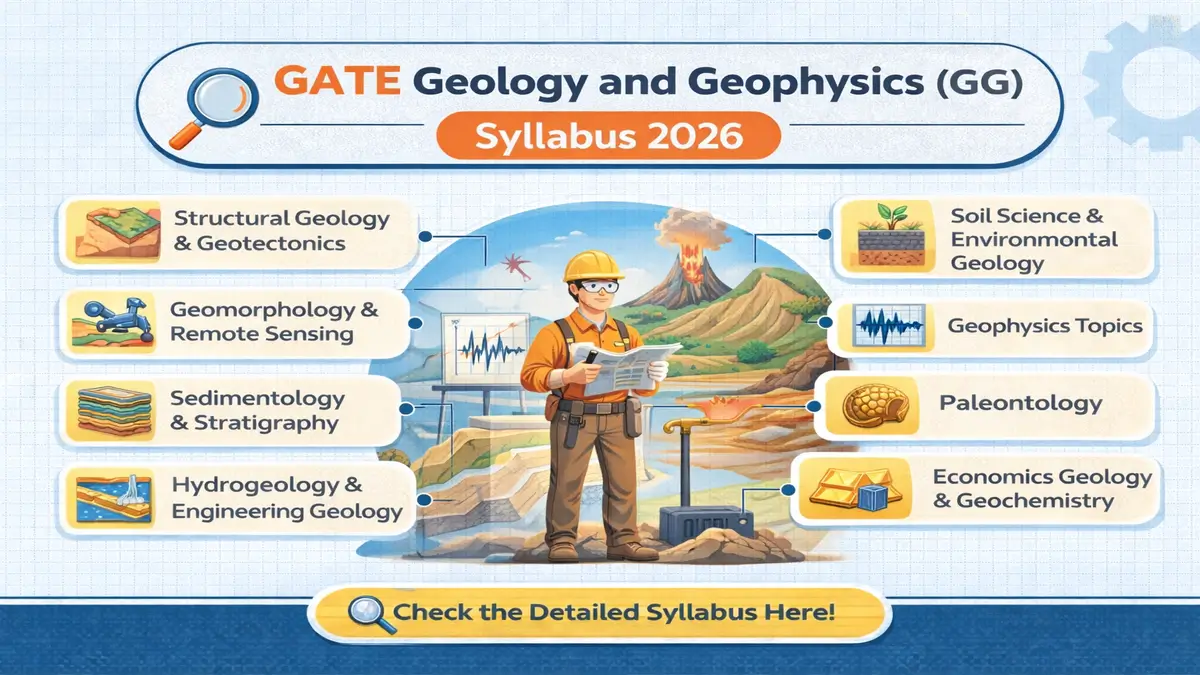
GATE Geology and Geophysics Syllabus 2026
The GATE Exam Syllabus 2026 is divided into three parts: General Aptitude, Part A (Common Section), and Part B (Selectable Section). To ace the GATE 2026 Exam and get admission in a reputed college or a job in a reputed organisation for Geology and Geophysics. Knowing the GATE GG Syllabus 2026 will help candidates aspiring for GATE 2026 to get good marks and success, as they can plan and strategise beforehand according to the GATE Geology and Geophysics Syllabus 2026. Below, we have provided the direct download link of the GATE GG Syllabus 2026.
GATE Geology and Geophysics Syllabus 2026 PDF Link
GATE GG Exam Pattern and Marking Scheme 2026
To get a high score, the first step is to understant marks distribution and marking scheme. Which is described in detail in the table below:
| GATE CG Exam Pattern 2026 | ||
| Section | Number of Questions | Total Marks |
| General Aptitude (GA) | 10 | 15 Marks |
| Part A (Common Section) | 25 | 25 Marks |
| Part B (Geology or Geophysics) | 30 | 60 Marks |
| Total | 65 | 100 Marks |
- Negative Marking: For 1-mark MCQs, 1/3 mark will be deducted, while for 2-mark MCQs, 2/3 mark will be deducted.
- No Negative Marking: Multiple Select Questions (MSQs) and Numerical Answer Type (NAT) questions have no penalty for wrong answers.
GATE 2026 Score Card – Click Here to Check
GATE 2026 Result Out – Click Here to Check
GATE GG (Part A) Common Section Syllabus 2026
This Part is compulsory for all candidates, even if they choose Geology or Geophysics in Part B. It covers the fundamental principles of Earth Sciences.
- Earth and Planetary System: Size, shape and internal structure of the Earth; concept of isostasy; seismology (body and surface waves).
- Geomorphology: Weathering, soil formation and landforms (fluvial, aeolian, glacial and volcanic).
- Structural Geology: Stress, strain, and material response; folds, faults and nomenclature of brittle/ductile deformation.
- Mineralogy & Crystallography: Silicate structures and common rock-forming minerals.
- Petrology: Basics of igneous, sedimentary and metamorphic rocks.
- Stratigraphy & Geochronology: Geological time scale and major stratigraphic divisions of India.
- Economic Geology: Basics of mineral, coal and petroleum resources in India.
- Applied Geology: Remote sensing basics, hydrogeology and engineering properties of rocks.
GATE GG Part B (Geology) Syllabus 2026
Candidates who select Geology in the selectable section must focus on advanced geological mapping, petrology, and fossil studies.
Geomorphology & Remote Sensing
- Geomorphic processes, tectonic geomorphology, and evolution of landforms.
- Digital image processing and multispectral remote sensing.
Petrology & Geochemistry
- Igneous: Magmatic differentiation, phase diagrams (binary/ternary), and mantle plumes.
- Sedimentary: Textures, sedimentary facies, and basin analysis of Indian basins.
- Metamorphic: Facies, grade, and thermobarometry.
- Geochemistry: Cosmic abundance of elements, meteorites, and isotope geochemistry.
Paleobiology & Stratigraphy
- Paleontology: Invertebrate morphology, microfossils (foraminifera), and vertebrate paleontology (Equus, Human).
- Stratigraphy: Sequence stratigraphy and Precambrian/Phanerozoic stratigraphy of India.
GATE GG Part B (Geophysics) Syllabus 2026
Candidates who select Geophysics in the selectable section focus on the physical properties of the Earth and exploration techniques.
Solid-Earth Geophysics & Geodesy
- The Earth as a planet, Clairaut’s theorem, the gravity field, and paleomagnetism.
- Seismology and interior of the Earth (density and pressure variations).
Seismic & Magnetic Methods
- Seismic: Reflection and refraction surveys, elastic wave propagation, and CDP surveys.
- Magnetic: IGRF, magnetometers, and magnetic susceptibility of rocks.
Electrical & Electromagnetic Methods
- Electrical: D.C. resistivity, apparent chargeability, and depth of investigation.
- Electromagnetic: Maxwell’s equations, skin depth, and airborne EM methods.
Geophysical Signal Processing
- Sampling theorem, Nyquist frequency, Fourier and Hilbert transforms, and digital filters.


 Ordnance Factory Khamaria Recruitment 20...
 SSC JE Mains Admit Card 2026 Out, Downlo...
 NBCC JE Recruitment 2026, Apply Online F...