Correct option is B
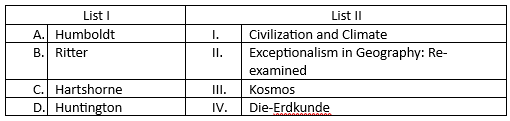
Alexander von Humboldt is credited with the preparation of the world’s first map with isotherms. He is often referred to as the father of modern geography due to his comprehensive and scientific approach to understanding the physical world. Humboldt introduced the concept of isotherms, lines connecting points of equal temperature, which became foundational in climate studies.
Information Booster
· Alexander von Humboldt made significant contributions to physical geography and climatology.
· The map with isotherms helped identify global climate patterns for the first time.
· He laid the groundwork for the study of ocean currents and their impact on climate.
· Humboldt's work influenced the development of environmental and geographical sciences.
· His expedition to the Americas provided critical data for these discoveries.
Additional Knowledge
·
Blache (Paul Vidal de la Blache): Known for his contributions to human geography and the concept of possibilism.
·
Huntington (Ellsworth Huntington): Studied the influence of climate on civilization and proposed theories on climatic determinism.
·
Ratzel (Friedrich Ratzel): A key figure in political geography and geopolitics, known for the "organic theory" of the state.
 English
 10 Questions
 20 Marks
 12 Mins