Correct option is B
A phase transition (or phase change) is the physical process of transition between one state of a medium and another. Commonly the term is used to refer to changes among the basic states of matter: solid, liquid, and gas, and in rare cases, plasma. A phase of a thermodynamic system and the states of matter have uniform physical properties. During a phase transition of a given medium, certain properties of the medium change as a result of the change of external conditions, such as temperature or pressure. This can be a discontinuous change; for example, a liquid may become gas upon heating to its boiling point, resulting in an abrupt change in volume. The identification of the external conditions at which a transformation occurs defines the phase transition point.
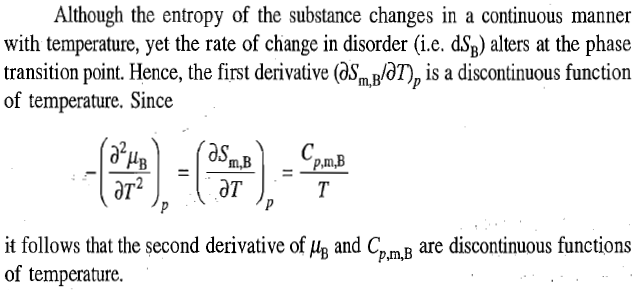
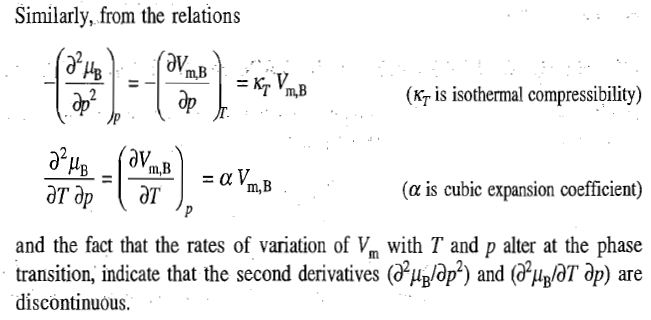
In a second order phase transition of a substance B, the chemical potential and its derivatives

are continuous functions of temperature whereas the second derivatives are discontinuous.
The fact that the first derivatives are continuous implies that changes in the values of enthalpy and volume during transition are zero. In other words, the entropy, the enthalpy and the volume of the system do not change when the transition occurs.