Correct option is D
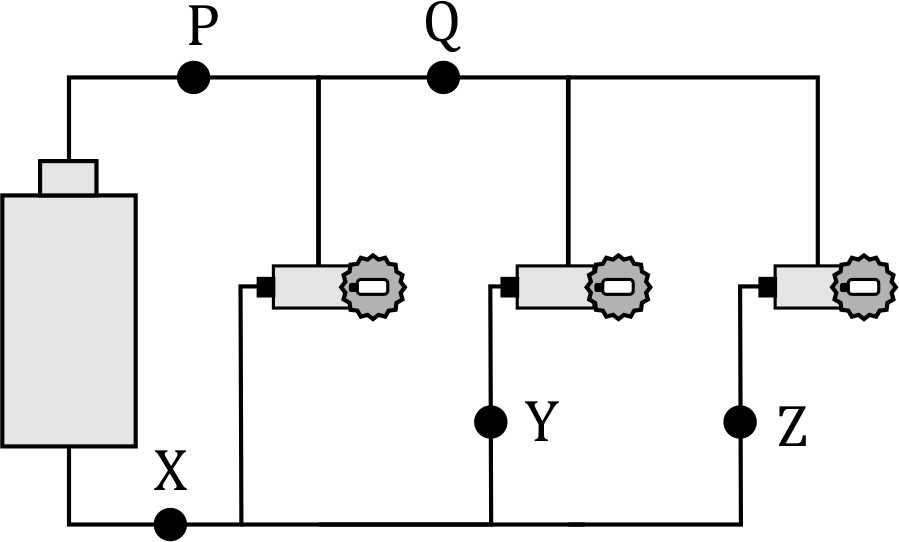
The correct answer is (D) The current at P is greater than the current at Q.
In this circuit, the current from the battery (point P) splits into two branches. The current at point P flows to both light bulbs in parallel, meaning the total current from the battery is divided between the two branches.
At point Q, the current has already split between the two branches (one branch leading to bulb X and the other to bulbs Y and Z in series).
Because the current at point P is the total current from the battery, and at Q, it's divided, the current at Q will be less than the current at P.
Information Booster:
In a parallel circuit, the total current divides among the branches, and the current is higher at the point where it is entering the circuit (P).
Bulb X is in parallel with the combined bulbs Y and Z, so the current divides based on the resistance of the two branches.
The current at Q is less than the current at P because Q is a point where the current has split.
 English
 100 Questions
 100 Marks
 90 Mins