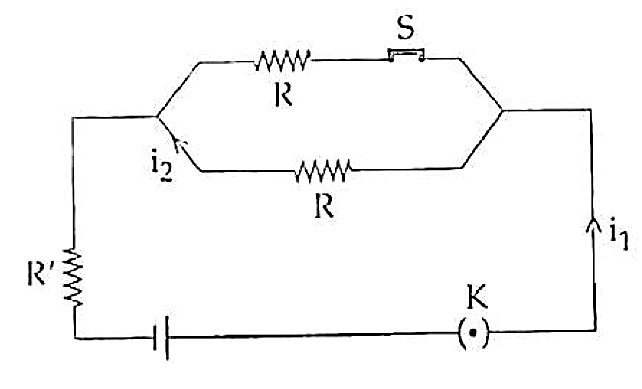
Correct option is D
The correct answer is (d) Lower resistance
Explanation:
- Electrical power (P) is the rate at which electrical energy is consumed in a circuit.
- When components are connected across the same constant voltage source $(V)$, the relevant formula relating power and resistance is: $P = \frac{V^2}{R}$.
- In this formula, power $(P)$ is inversely proportional to the resistance $(R)$.
- Therefore, a combination with a lower resistance will allow a significantly higher current to flow, thereby consuming more electrical power.
Information Booster:
- If resistors are connected in a parallel combination, the equivalent overall resistance heavily decreases, thereby drawing more power from the source.
- If resistors are connected in a series combination, the equivalent overall resistance increases, lowering the total power consumed from a given voltage source.
- The SI unit of electrical power is the Watt (W).
Additional Knowledge:
Higher resistance (Option a)
- A higher resistance drastically restricts the current flow. According to $P = \frac{V^2}{R}$, this results in less power consumed.
Equal resistance (Option b)
- This simply draws power proportional to that singular resistance value, not "more" by comparison.
Zero resistance (Option c)
- A literal zero resistance creates a "short circuit", mathematically causing power to trend toward infinity and practically causing wire failure, but lower resistance is the standard conceptual answer in resistor comparisons.
So the correct answer is (d)
 English
 100 Questions
 100 Marks
 90 Mins