arrow
arrow
arrow
The stopping potential for photoelectrons emitted from a surface illuminated by light of frequency 6.0×10⁸MHz is 0.72V. When the incident frequen
Question

The stopping potential for photoelectrons emitted from a surface illuminated by light of frequency 6.0×10⁸MHz is 0.72V. When the incident frequency is changed, the stopping potential is found to be 1.44V. The new frequency is approximately (e/h=2.4×1014CJ-1s-1)


A.

7×10⁸

B.

4×10⁸

C.

2×10⁹

D.

7×10¹⁴

Correct option is D

The photoelectric effect is the emission of electrons from a material caused by electromagnetic radiation such as ultraviolet light. Electrons emitted in this manner are called photoelectrons.

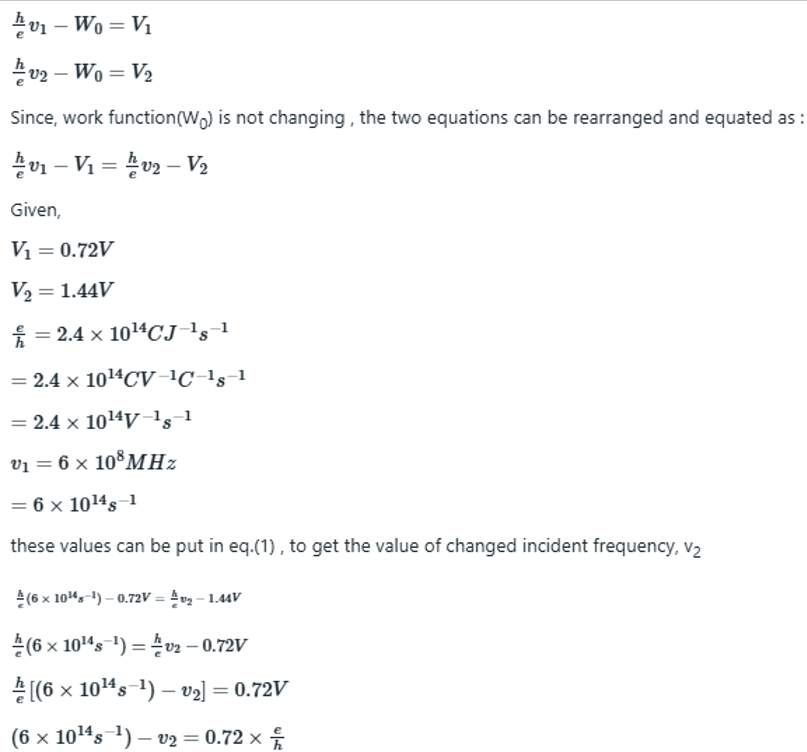
In photoelectric effect, the electron ejected posses some kinetic energy which is proportional to the frequency of incident radiation. Stopping potential is minimum potential that is needed to stop or slow down the ejected electron before it reaches the anode. Minimum potential that is needed, must be equivalent to the kinetic energy of electron, which is further related to the applied frequency (v) and the work function of metal as follows:


Similar Questions

test-prime-package

Access ‘CSIR NET Chemical Sciences’ Mock Tests with

  • 60000+ Mocks and Previous Year Papers
  • Unlimited Re-Attempts
  • Personalised Report Card
  • 500% Refund on Final Selection
  • Largest Community
students-icon
353k+ students have already unlocked exclusive benefits with Test Prime!
test-prime-package

Access ‘CSIR NET Chemical Sciences’ Mock Tests with

  • 60000+ Mocks and Previous Year Papers
  • Unlimited Re-Attempts
  • Personalised Report Card
  • 500% Refund on Final Selection
  • Largest Community
students-icon
353k+ students have already unlocked exclusive benefits with Test Prime!
Our Plans
Monthsup-arrow