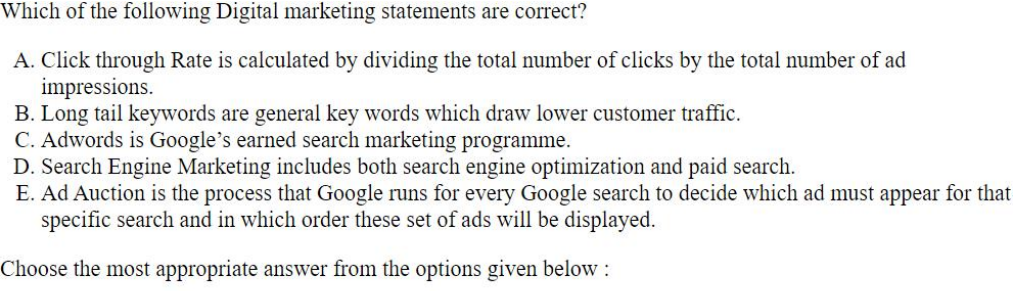
Correct option is B
The Nicosia Model focuses on the relationship between the firm and the consumer, highlighting how marketing communication shapes consumer attitudes and decision-making. The three major components are:
A. The consumer's attitude based on firm's message exposure: Consumers develop attitudes after being exposed to marketing messages from the firm.
C. Feedback in the form of purchase experience: Consumer purchase experience acts as feedback, influencing future decisions and firm communication strategies.
E. Consumer's product search and evaluation: Consumers engage in searching for information and evaluating products before making a purchase decision, which is a crucial component of the model.
While B (Perceptual and learning constructs) and D (Extensive problem solving by consumer) are important in consumer behavior literature, they are not specifically highlighted as core components of the Nicosia Model.
Information Booster:
The Nicosia Model is a communication-based model that demonstrates how consumers’ attitudes change through firm-consumer interaction. The model has four main components:
Firm’s message exposure shaping consumer attitudes.
Consumer’s search and evaluation process (product search and evaluation).
Consumer’s decision or purchase behavior.
Feedback loop from purchase experience impacting the firm’s future marketing efforts.
This model is unique because it focuses on the feedback process and the interactive nature of consumer decision-making, highlighting that communication is a two-way process.
Additional Knowledge:
B (Perceptual and learning constructs): These are more aligned with psychological models of consumer learning and perception rather than Nicosia’s communication focus.
D (Extensive problem solving): This is a type of decision-making process highlighted in other consumer models, such as Engel-Kollat-Blackwell, but not emphasized in Nicosia’s framework.
 English
 10 Questions
 20 Marks
 12 Mins