
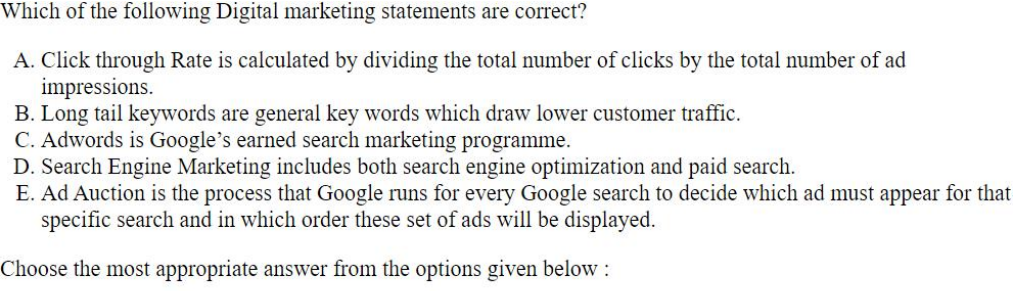
Correct option is D
Introduction:
In digital marketing, understanding key performance metrics and the structural elements of search marketing is essential. In the provided question from image_b069dc.jpg, statements A, D, and E are facts regarding core digital metrics and search engine logic.
Specifically, Click-Through Rate (CTR) is calculated precisely by dividing clicks by total impressions (Statement A). Search Engine Marketing (SEM) historically and conceptually serves as an umbrella term that includes both organic SEO and paid search methods (Statement D). Finally, the Ad Auction is the instantaneous, automated process Google utilizes during every single query to evaluate eligible ads and determine their specific placement order (Statement E). Thus, the correct option is 4 (A, D and E only).
Information Booster:
Click-Through Rate (CTR): It measures the percentage of people who click an ad after seeing it. The formula is expressed as:
Search Engine Marketing (SEM) Ecosystem: While modern marketers often use SEM to refer solely to paid search, standard academic frameworks define SEM broadly as the comprehensive discipline of increasing website visibility on search engine results pages (SERPs) through both organic optimization (SEO) and paid contextual advertising.
Google Ad Auction Mechanism: Every time a user enters a query into Google, an automated auction takes place. Google evaluates all competing advertisers based on their Maximum Bid and Quality Score (which tracks ad relevance, expected CTR, and landing page experience) to calculate an Ad Rank that determines layout positioning.
Additional Knowledge:
Statement B is incorrect: Long-tail keywords are not "general" keywords. Instead, they are highly specific, multi-word phrases (e.g., "best organic coffee beans for cold brew"). While it is true that individual long-tail keywords draw lower search volume on their own, they collectively account for a massive chunk of search traffic and yield significantly higher conversion rates due to clear user intent.
Statement C is incorrect: Google Ads (formerly Google AdWords) is a paid search marketing program (Pay-Per-Click), not an "earned" search marketing program. Earned media refers to organic exposure gained through word-of-mouth, SEO content authority, or public relations.
 English
 10 Questions
 20 Marks
 12 Mins


