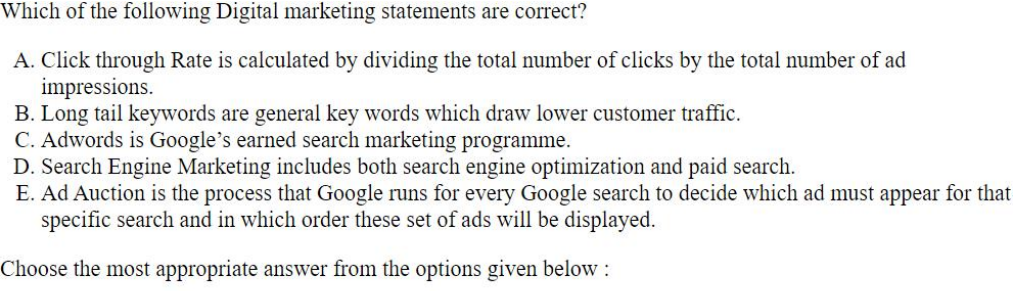
Correct option is B
The Retail Accordion Theory explains the cyclical expansion and contraction of product assortment in retail institutions. According to this theory, retail formats alternate between wide (general) and narrow (specialized) assortments of merchandise over time.
The theory posits that a retailer may begin as a generalist offering a broad range of products, then narrow its focus to specialize in a specific category to gain expertise and competitive advantage. Eventually, in pursuit of growth or diversification, the retailer may broaden its offerings again, returning to a general merchandise strategy — hence the name "accordion" which metaphorically represents expansion and contraction.
Information Booster:
Coined by Hollander (1960s) to explain merchandise mix changes in retail evolution.
Suggests that retailers expand and contract their product lines cyclically.
Retailers evolve between general merchandise and specialization as part of strategic repositioning.
Influenced by consumer preferences, market competition, and cost structures.
Seen in the growth of outlets like department stores and supermarkets which shift from general to specialized and back to broader formats.
Helps explain long-term strategic trends in retail evolution and business model transformation.
Additional Knowledge:
(a) Wheel of Retailing Theory
Describes how new retailers enter the market with low prices and basic services, then gradually upgrade and increase prices, becoming vulnerable to new low-cost entrants. It focuses on price and service evolution, not assortment breadth.
(c) Theory of Natural Selling
Not a formally recognized theory in academic retail literature. This is not relevant to the retail evolution described in the question.
(d) Retail Life Cycle Theory
Explains retail evolution through four stages: Introduction, Growth, Maturity, and Decline. It focuses on life cycle stages of retail formats, not the alternation between general and specialized formats.
 English
 10 Questions
 20 Marks
 12 Mins