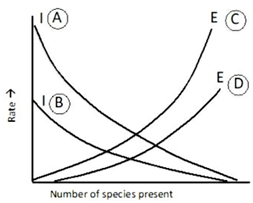
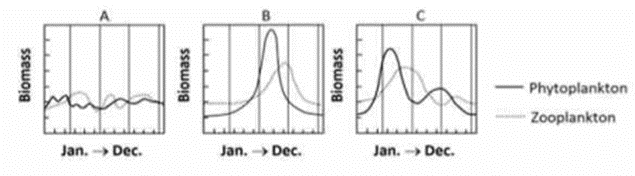
Correct option is C
Explanation-
A. Biological fixation in oceans — Highest
Reason: Marine cyanobacteria (like Trichodesmium) fix large amounts of nitrogen. Oceans cover ~70% of Earth, offering vast areas for nitrogen fixation. Although individual rates are low, the global total is very high due to scale.
Highest nitrogen fixation rate
B. Fixation by lightning — Lowest
Reason: Lightning breaks N₂ into reactive nitrogen compounds (like NOx), but It's a rare, weather-dependent process and contributes less than 10 Tg N/year globally.
Lowest among the listed
C. Biological fixation in natural terrestrial systems
Reason: Includes nitrogen-fixing bacteria in root nodules of legumes (e.g., Rhizobium). More active than lightning but less than oceans and industrial processes.
Intermediate in the list
D. Industrial nitrogen fixation
Reason: Through the Haber-Bosch process, converting atmospheric N₂ to ammonia (NH₃) can be used in fertilizer production; has grown rapidly due to agriculture. It fixes over 120 Tg N/year.
Less than oceans globally, but more than natural terrestrial fixation.
Second-highest
So, the correct order should be B<C<D<A (Option c)