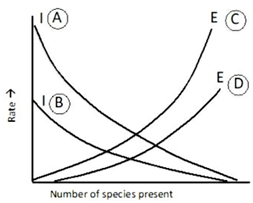
Correct option is C
Explanation-
In the 1960s, MacArthur and Wilson developed the Theory of Island Biogeography, which predicts species richness on islands based on colonization and extinction rates. Their key conclusion was over time, an island will reach an equilibrium where the rate of species immigration (colonization) equals the rate of species extinction. This does not mean the species composition stays the same — just the overall number of species tends to remain relatively stable.
Incorrect Options -
Option a - "The rate of extinction and colonization are not equal to each other."
This is partially true at specific times, but the main finding was about long-term equilibrium, not momentary inequalities.
Option b - "The colonization rates gradually exceed extinction rates."
Initially, colonization may exceed extinction, but eventually, they balance — so this is not accurate over a long period.
Option d - "Rate of colonization will continue to increase while extinction rates will decline."
This contradicts the equilibrium model. Colonization actually declines over time (as fewer new species remain to colonize), and extinction increases (as competition grows).
Correct answer: Option c
"The overall rate of colonization will be balanced by the rate of extinction."