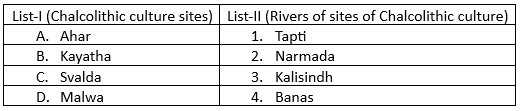
Correct option is D
The correct answer is (d) Madhya Pradesh
Explanation:
- The Kayatha Culture is a Chalcolithic (Copper-Bronze Age) culture of Ancient India, primarily associated with the region of Madhya Pradesh.
- This culture is named after the site of Kayatha, located near Ujjain in Madhya Pradesh. It is characterized by early agricultural practices, the use of copper tools, and distinctive pottery.
- The Kayatha Culture is believed to be contemporaneous with the Harappan Civilization in some respects and marks an important phase in the transition to more settled agricultural life during the Chalcolithic period.
Information Booster:
Kayatha Culture – Overview and Key Features
Aspect | Details |
Location | Named after the Kayatha site in Ujjain district, Madhya Pradesh. Ancient name was Kapitthaka, the birthplace of the astronomer Varaha. |
Time Period | Flourished between 2000 BCE to 1500 BCE. |
Trade and Economy | The Kayatha people were involved in trade and had interactions with the Harappan civilization, as evident in their material culture. |
Settlement Pattern | Settled in villages with mud-brick structures and focused on agriculture. |
Ceramics | Pottery included bowls, storage jars, basins, and chocolate slipped ware. About 60% of pottery was coarse handmade red/grey ware. |
Tools and Ornaments | Used both copper and stone tools. Ornaments found included bead necklaces made from semi-precious stones. |
Lifestyle and Economy | - Huts with thatched roofs, well-rammed floors, and wattle and daub walls. |
Agriculture | Barley and wheat were cultivated. Domesticated animals included cattle, sheep, and goats. Horse remains found at the Chalcolithic level. |
End of the Culture | The culture is believed to have ended due to a possible earthquake. |
Significance: The Kayatha Culture represents a shift in the Chalcolithic period, where early human societies began to experiment with metalworking, especially copper, and domestic agriculture.
Additional Knowledge:
- Punjab is associated with the Indus Valley Civilization (Harappan Culture). Ropar and Banawali are Indus Valley Civilization (IVC) sites in Punjab.
- Maharashtra is associated with other Chalcolithic cultures like the Jorwe Culture .The Jorwe culture site is located in the Ahmednagar district of Maharashtra,
- Rajasthan is home to several important ancient cultures, including the Ahar-Banas Culture (Neolithic and Chalcolithic).
 English
 100 Questions
 100 Marks
 90 Mins