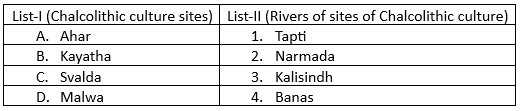
Correct option is B
The Correct Answer is B: central Narmada basin.
Explanation:
- Malwa culture (1900-1400 BCE) was a prominent Chalcolithic culture of central India.
- It was primarily found in the Narmada basin, with key sites like Navdatoli and Eran.
Key Points:
- Malwa culture developed advanced agriculture and pottery techniques.
- Characterized by black-on-red painted pottery.
- Inhabited fortified settlements with planned structures.
Additional Information:
- Paleolithic Age (2.5 million BCE – 10,000 BCE): Early human evolution, stone tools, hunter-gatherers.
- Mesolithic Age (10,000 BCE – 8000 BCE): Transition to agriculture, microlithic tools.
- Neolithic Age (8000 BCE – 2000 BCE): Beginning of farming, domestication of animals, permanent settlements.
- Chalcolithic Age (3000 BCE – 700 BCE): Copper tools, pottery, and early trade networks.
- Bronze Age (3300 BCE – 1300 BCE): Indus Valley Civilization flourished.
- Iron Age (1200 BCE – 600 BCE): Use of iron tools, Vedic period, emergence of Mahajanapadas.
 English
 80 Questions
 160 Marks
 60 Mins