Correct option is D
Given:
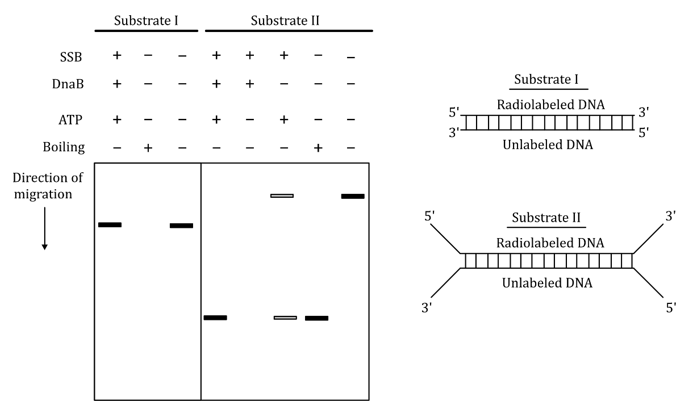
Substrate I: Fully double-stranded DNA with radiolabeled strand.
Substrate II: Partially unwound DNA (forked), with radiolabeled strand.
Conditions tested: Presence/absence of SSB, DnaB, ATP, and boiling control.
Step-by-step analysis of statements:
A. DnaB can unwind only a partially unwound DNA.
From the gel:
Substrate I shows no unwinding bands with DnaB (+/- SSB), meaning DnaB cannot unwind fully duplex DNA.
Substrate II shows unwinding bands with DnaB, indicating it unwinds partially unwound DNA (forked substrate).
Therefore, A is correct.
B. SSB inhibits the unwinding activity of DnaB.
SSB binds single-stranded DNA and usually helps stabilize unwound strands, assisting helicase action.
From the gel:
With SSB (+), unwinding is either enhanced or remains the same (no inhibition seen).
So, B is incorrect.
C. DnaB unwinds DNA in the 5’ to 3’ direction.
To conclude unwinding direction from these data alone requires detailed substrate design and strand labeling interpretation.
In the given diagram, the radiolabeled strands are designed to detect 5' to 3' or 3' to 5' unwinding.
However, the data do not definitively prove the unwinding direction here, only that unwinding happens on substrate II.
So, this statement cannot be confirmed purely from the gel shown, making C incorrect for this question's purpose.
D. DnaB requires ATP for DNA unwinding.
The gel shows unwinding bands only in presence of ATP (+ lanes).
Without ATP, no unwinding occurs.
Hence, D is correct.