

arrow
arrow
arrow
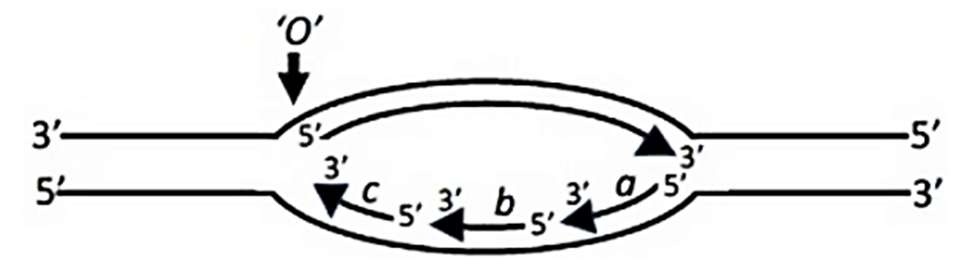
​In the figure above, replication of DNA beginning from the origin of replication of the chromosome of a newly identified bacterium having a double-st
Question

In the figure above, replication of DNA beginning from the origin of replication of the chromosome of a newly identified bacterium having a double-stranded circular DNA genome is shown. Characterization of DNA polymerase responsible for genome replication showed that DNA synthesis occurred in 5’ to 3’ direction and it depends on the presence of a primer (as is the case in Escherichia coli). Polarities of DNA (5’ or 3’) are as shown. Replication begins at a point marked ‘o’ on the left of the bubble, and both the parent strands were replicated concurrently. The longer arrow inside the bubble shows the leading strand, whereas the shorter arrows (marked a, b, c) show the Okazaki fragments.

A.

Bidirectional mode of replication wherein synthesis of the Okazaki fragment marked ‘c’ occurs prior to those marked ‘a’ and ‘b’​​

B.

Bidirectional mode of replication wherein synthesis of the Okazaki fragment marked ‘a’ occurs prior to those marked ‘b’ and ‘c’

C.

Unidirectional mode of replication wherein synthesis of the Okazaki fragment marked ‘c’ occurs prior to those marked ‘a’ and ‘b’

D.

Unidirectional mode of replication wherein synthesis of the Okazaki fragment marked ‘a’ occurs prior to those marked ‘b’ and ‘c’

Correct option is C

Explanation-

​DNA replication starts at origin 'O'. DNA synthesis proceeds in the 5' to 3' direction only. The replication bubble shows bidirectional opening, but the nature of the fragments helps determine actual directionality. The leading strand is continuous, whereas the lagging strand is synthesized discontinuously via Okazaki fragments (a, b, c).
Observation from the figure:
On the right fork, the Okazaki fragments are labeled a (closest to fork), then b, then c. Since DNA synthesis is 5' to 3', the latest fragments are closest to the fork. So, fragment c (farthest from the fork) must have been made first, then b, then a.
This clearly shows that Fragment c was synthesized before a and b. The replication fork is progressing in a single direction from 'O', not both.

So, correct answer:
Option c : Unidirectional mode of replication wherein synthesis of the Okazaki fragment marked ‘c’ occurs prior to those marked ‘a’ and ‘b’.

Similar Questions

test-prime-package

Access ‘CSIR NET Life Sciences’ Mock Tests with

  • 60000+ Mocks and Previous Year Papers
  • Unlimited Re-Attempts
  • Personalised Report Card
  • 500% Refund on Final Selection
  • Largest Community
students-icon
353k+ students have already unlocked exclusive benefits with Test Prime!
test-prime-package

Access ‘CSIR NET Life Sciences’ Mock Tests with

  • 60000+ Mocks and Previous Year Papers
  • Unlimited Re-Attempts
  • Personalised Report Card
  • 500% Refund on Final Selection
  • Largest Community
students-icon
353k+ students have already unlocked exclusive benefits with Test Prime!
Our Plans
Monthsup-arrow
