Correct option is A
Explanation-
Option A - "Once DNA replication commences, it always continues uninterrupted until the entire process is complete."
DNA replication does not always proceed smoothly from start to finish. Replication forks can encounter obstacles, such as:
1. DNA damage (e.g., UV-induced thymine dimers or oxidative lesions)
2. Tightly bound proteins on DNA
3. Secondary DNA structures, like G-quadruplexes
4. Lack of nucleotides or topological stress
5. Transcription-replication conflicts
When replication forks stall, the cell , it activates DNA damage checkpoints (e.g., ATR, ATM pathways in eukaryotes) and pauses replication. It repairs the damage or removes the block and restarts replication via specialized fork restart proteins (e.g., RecQ helicases, DNA polymerase restart complexes)
Example - In eukaryotes, if replication is stalled:
The replication checkpoint (e.g., ATR-CHK1) prevents further origin firing and cell cycle progression.
In prokaryotes, stalled forks can collapse and require recombination-mediated restart (RecA pathway).
DNA replication can be interrupted and does not always proceed continuously. So, this statement is factually incorrect.
Correct options-
Option B - "Eukaryotic genomes replicate from multiple origins of replication."
This is correct . Eukaryotic DNA is long and linear (millions to billions of base pairs). To replicate within the limited time of S-phase, eukaryotes use - Multiple replication origins (e.g., ~30,000–50,000 origins in humans) so multiple origins are essential for timely replication. These origins are activated in a temporal manner (some early, some late in S-phase) and controlled by licensing factors like ORC, Cdc6, Cdt1, and MCM complex
Option C - "A consensus sequence for the origins of DNA replication has been identified in Saccharomyces cerevisiae."
In S. cerevisiae (budding yeast) origins of replication are well-characterized called ARS (Autonomously Replicating Sequences). These ARS elements contain a conserved consensus sequence known as ARS Consensus Sequence (ACS): ~11 bp long, necessary for origin function
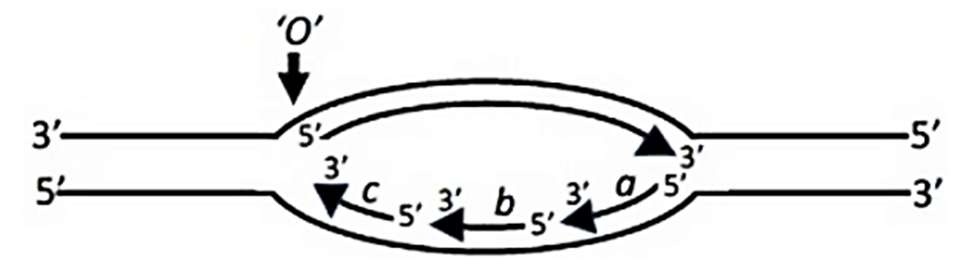
Option D - "Both, fully methylated as well as non-methylated oriC can initiate DNA replication, while hemi-methylated oriC does not."
In E. coli:
1. Only fully methylated oriC can efficiently initiate replication.
2. Hemi-methylated oriC is blocked by SeqA (temporarily inactive).
3. Non-methylated oriC can potentially bind DnaA under artificial or experimental conditions but is not the normal state.
However, some studies do suggest that non-methylated oriC (artificial/plasmid-based systems) can be used to initiate replication under certain conditions.
While biologically limited, it’s not absolutely false in all contexts — hence not the most incorrect statement.
Since option A is the only incorrect option among all the other options that makes it a correct answer.