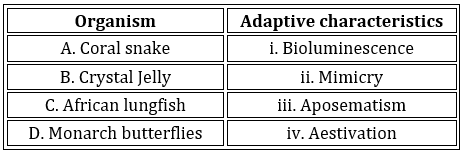
Correct option is A
Explanation-
A - Coral snake → Mimicry (ii)
Although coral snakes themselves are venomous and use aposematism (warning coloration), the twist here is that they are part of a mimicry system—where non-venomous species (e.g., king snakes) mimic them. Thus, in a mimicry-based question, it's acceptable (if slightly debatable) to list coral snakes as associated with mimicry. However, in evolutionary ecology, coral snakes are key models in a mimicry system called - Batesian mimicry, where non-venomous snakes (e.g., king snakes) mimic coral snakes to avoid predation. Though the coral snake is the model and not the mimic, it is still part of a mimicry system, which justifies matching it to "Mimicry" in this context.
B - Crystal Jelly → Bioluminescence (i)
Undeniably correct. Crystal jellies are famous for producing green fluorescent protein (GFP). Crystal jellies (Aequorea victoria) are marine organisms famous for producing bioluminescence. They contain Aequorin (a blue-light emitting protein) and GFP (Green Fluorescent Protein), widely used in molecular biology. This glow helps them in predator avoidance, communication, and prey attraction in the dark ocean.
C - African lungfish → Aestivation (iv)
During dry seasons, when water bodies evaporate, they burrow into mud, form a mucous cocoon and enter a dormant state called aestivation. This state reduces metabolism and allows survival for months or even years. This is aestivation.
D - Monarch butterflies → Aposematism (iii)
Monarchs feed on milkweed plants, which contain cardiac glycosides (toxic compounds). These compounds accumulate in their bodies, making them unpalatable or toxic to predators. Their bright orange and black coloration serves as a warning signal — this is known as aposematism. Birds that eat a monarch learn to avoid them in the future due to bad taste or toxicity.
A – ii. Mimicry
B – i. Bioluminescence
C – iv. Aestivation
D – iii. Aposematism
Correct answer:
Option a — A-ii, B-i, C-iv, D-ii