Correct option is C
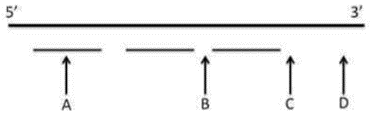
Explanation: DNA polymerase III requires a 3’ hydroxyl group to add nucleotides during DNA replication. For it to function as a substrate, a DNA molecule must have a free 3' OH group to begin extension. Molecules with nicks (single-stranded breaks) or incomplete 3' ends will not function as proper substrates for DNA polymerase III.
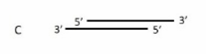
Molecule C lacks a 3’ hydroxyl group at the free end and therefore cannot serve as a substrate for DNA polymerase III.
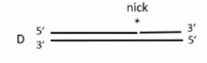
Molecule D has a nick. While nicks can be useful for certain DNA polymerases, DNA polymerase III specifically requires a complete 3' OH group to initiate replication.
Thus, C and D cannot function as substrates for DNA polymerase III.
Information Booster:
DNA polymerase III requires a 3’ hydroxyl group for the addition of nucleotides.
Molecule C does not have a free 3' OH group, making it incapable of serving as a substrate for polymerase III.
Molecule D contains a nick, which prevents the polymerase from functioning properly, as polymerase III requires a continuous strand for elongation.
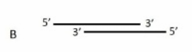
Molecule A and B both have suitable 3' OH ends for the polymerase to begin replication.
Nicks in DNA strands generally require other repair mechanisms to be dealt with before replication can continue.
DNA polymerase III is essential for the elongation of the new strand during DNA replication, starting from a primer or 3' OH group.
Additional Information:
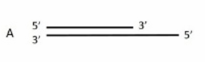
Molecule A: Contains the necessary 3’ end for DNA polymerase III to extend the strand.
Molecule B: Contains a free 3’ hydroxyl group, making it a functional substrate for DNA polymerase III.