Correct option is B
Correct Answer: (2) B and C
Explanation:
Let's evaluate the correctness of each statement:
A. Change of DNA sequence from AGC to ATC in non-coding strand can have a major impact on the protein production.
Correct: A change in the DNA sequence in the non-coding strand can indeed affect protein production. This is because the non-coding strand serves as the template for mRNA transcription, and a mutation in this strand can result in a change in the mRNA, which can impact protein synthesis. The impact on protein production depends on whether the mutation affects the coding region (via changes in mRNA sequence).
B. Suppressor mutation restores the original phenotype, only when a second mutation occurs at the original site of the mutation.
Incorrect: This is incorrect. A suppressor mutation can restore the original phenotype by occurring at a different location (not necessarily the original mutation site). A suppressor mutation compensates for the effect of the first mutation but is not required to occur at the original site.
C. Mutation rates remain the same in all organisms.
Incorrect: This is incorrect. Mutation rates vary significantly across organisms. Factors such as replication mechanisms, DNA repair efficiency, environmental factors, and replication speed all influence mutation rates. Some organisms, such as viruses or bacteria, may have much higher mutation rates than others.
D. Strand slippage during replication is a consequence of loop formation in one strand of DNA.
Correct: This is correct. Strand slippage occurs when the DNA polymerase encounters regions of repetitive DNA or misalignments during replication. This causes the DNA strand to form a loop, leading to insertions or deletions in the new DNA strand.
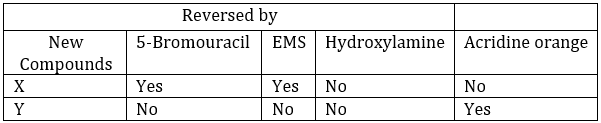
E. Hydroxylamine adds a hydroxyl group only on cytosine.
Correct: This is correct. Hydroxylamine is a chemical mutagen that specifically adds a hydroxyl group to cytosine, leading to a mutation where cytosine is converted to uracil. This can cause a transition mutation (cytosine to thymine).
Information Booster:
B (Suppressor mutation): A suppressor mutation can occur at a different site from the original mutation and restore the original phenotype. This means that a suppressor mutation does not always occur at the original mutation site, making statement B incorrect.
C (Mutation rates): Mutation rates are highly variable and depend on several factors. For instance, species with efficient DNA repair mechanisms, like some multicellular organisms, have lower mutation rates than rapidly reproducing organisms like bacteria. This makes statement C incorrect.