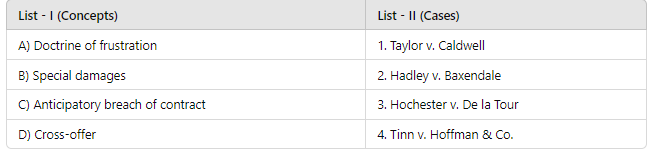
Correct option is C
Taylor vs. Caldwell, 122 ER 309, is a landmark case that established the Doctrine of Frustration in contract law. In this case, the contract became impossible to perform due to unforeseen circumstances—specifically, the destruction of a music hall that was essential to the contract's performance. The court held that the contract was frustrated and the parties were excused from their obligations. Under the Indian Contract Act, 1872, this principle is embodied in Section 56, which deals with the impossibility of performance. If a contract becomes impossible to perform or unlawful after it has been entered into, it becomes void, and the parties are discharged from their contractual obligations.
Information Booster
Doctrine of Frustration (Section 56 of the Indian Contract Act, 1872): The Doctrine of Frustration is a legal principle that discharges the parties from their contractual obligations when an unforeseen event renders the performance of the contract impossible or illegal. Under Section 56 of the Indian Contract Act, 1872, if an act becomes impossible after the contract is made, the contract becomes void. The Taylor vs. Caldwell case is one of the earliest and most influential cases that established this principle. The case sets a precedent that when the basis or the essential condition of the contract is destroyed, the contract is considered frustrated.
The Doctrine of Frustration is particularly important in contracts where the performance depends on the continued existence of a specific thing or the occurrence of a specific event. For example, if a contract involves the use of a particular venue and that venue is destroyed, the contract is frustrated.
Additional Knowledge
(a) Doctrine of Necessity: The Doctrine of Necessity is not directly related to the Taylor vs. Caldwell case. Instead, it is a principle that justifies the infringement of certain rights or obligations in situations of emergency or extreme necessity. This doctrine is more applicable in constitutional law and international law, where actions taken during emergencies may be considered lawful if they are necessary to preserve order or protect life.
(b) Offer: An offer is a fundamental concept in contract law but is unrelated to the Doctrine of Frustration. An offer is a proposal made by one party to another, indicating a willingness to enter into a contract on certain terms. If the offer is accepted, it becomes a binding contract. The concept of an offer is covered under Section 2(a) of the Indian Contract Act, 1872.
(d) Contingent Contract: A contingent contract is one that is dependent on the happening or non-happening of a future uncertain event. Such contracts are dealt with under Sections 31 to 36 of the Indian Contract Act, 1872. A contingent contract becomes enforceable only when the specified event occurs. However, this is different from a contract that becomes frustrated, as frustration involves an unforeseen event that makes the performance of the contract impossible or illegal, rather than an anticipated event on which the contract is contingent.