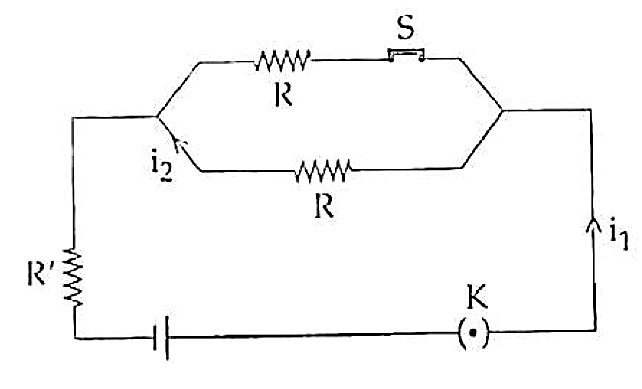
Correct option is C
To solve this problem, we will calculate the resistance of the silver wire and the aluminum wire separately using the formula for resistance:
R=ρAL
Where:
- Ris resistance
- ρ is resistivity
- L is length
Step 1: Calculate resistance of the silver wire
For the silver wire:
Rsilver=ρsilverAL
Given:
ρsilver=1.6×10⁻⁸Ωm,L=L,A=A
Rsilver=A1.6×10−8×L
Step 2: Calculate resistance of the aluminum wire
For the aluminum wire:
Raluminium=ρaluminiumAaluminiumLaluminium
Given:
ρaluminium=2.6×10⁻⁸Ωm,Laluminium=5L,Aaluminium=9A Raluminium=9A2.6×10−8×5L
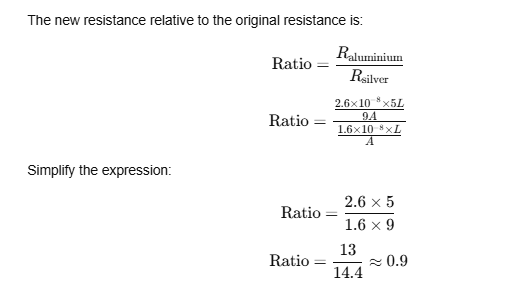
Step 3: Calculate the ratio of resistances
A is cross-sectional area
Final Answer:
The resistance of the circuit will decrease to 0.9 times of itself.
Correct Answer: C
Explanation:
The resistance of the circuit decreases because aluminum has a higher resistivity than silver but the effect of increasing the length and cross-sectional area results in an overall decrease in resistance by 10%.
Information Booster:
● Resistance depends on material properties (resistivity), length, and cross-sectional area.
● Increasing the length increases resistance linearly.
● Increasing the cross-sectional area reduces resistance inversely.
● Aluminum is less conductive than silver but is commonly used due to cost and availability.
● The ratio of resistivities and geometric changes determines the new resistance.







 English
 100 Questions
 100 Marks
 90 Mins