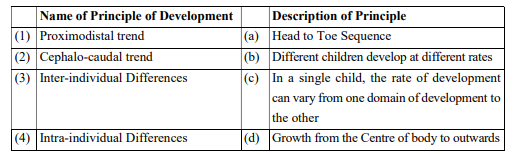
Correct option is A
The correct answer is (a) Physical development. The proximodistal principle of development refers to the pattern of growth that starts at the center of the body and moves outward toward the extremities. The word "proximo" means "near" and "distal" means "far." This principle explains how motor and muscular control in infants develops from the central parts of the body (such as the spine and torso) to the more peripheral parts (like the hands and fingers). For instance, a child first gains control over their shoulders and arms before developing the ability to control their hands and fingers. This reflects the natural progression of physical growth and motor coordination.
Information Booster:
- Proximodistal development begins prenatally when the central organs like the heart and lungs start forming before the limbs. After birth, infants gain control over their trunks and then progress to arms and legs, followed by hands and fingers.
- This principle is critical for understanding motor skill development. For example, before a child can grasp an object with fingers, they must be able to control their upper arms and shoulders.
- The cephalocaudal and proximodistal principles work together to explain the general order of physical growth and motor skill acquisition in children.
- Understanding these principles helps educators and caregivers set developmentally appropriate expectations for children's physical abilities at different stages.
- Delays or irregularities in the expected proximodistal pattern of development may signal developmental disorders or require intervention from pediatric professionals.
Additional Information:
- (b) Cognitive development: This refers to how children think, explore, and figure things out. It involves mental skills like memory, problem-solving, and language.
- (c) Emotional development: This includes the ability to recognize, express, and manage emotions. It is more related to psychological growth and socialization.
- (d) Personality development: Refers to the development of enduring patterns of behavior, feeling, and thinking. It is influenced by temperament, environment, and experiences.
 English
 150 Questions
 150 Marks
 150 Mins