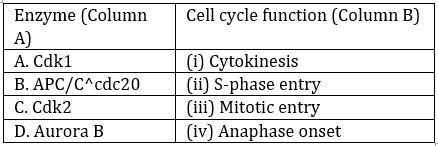
Correct option is C
The correct answer is activation of CDK1 requires post-translational modifications. Although mitotic cyclin (Cyclin B) accumulates gradually during the G2 phase, the activity of CDK1 (Cyclin-dependent kinase 1) does not immediately increase. This is due to the fact that CDK1 remains inactive until it undergoes key post-translational modifications, such as dephosphorylation of inhibitory phosphate groups and phosphorylation at activating sites.
Specifically, CDK1 is kept inactive by phosphorylation at Thr14 and Tyr15 by kinases such as Wee1, even though it is already bound to Cyclin B. Activation of the Cyclin B-CDK1 complex requires dephosphorylation of these residues by the CDC25 phosphatase, which occurs at the onset of mitosis. This results in a sudden switch-like activation of CDK1 activity, triggering entry into M phase. Therefore, it is not the level of cyclin that controls the timing but rather the regulatory phosphorylation/dephosphorylation events.
Information Booster:
- CDK1 is the key mitotic kinase involved in the transition from G2 to M phase.
- Binding to Cyclin B alone is not sufficient for CDK1 activation; it must be properly phosphorylated/dephosphorylated.
- Inhibitory phosphorylation (by Wee1 kinase) and activating dephosphorylation (by CDC25 phosphatase) are critical regulatory steps.
- This regulatory mechanism provides a checkpoint control ensuring that mitosis only begins when the cell is ready.
- The sudden activation of CDK1 leads to phosphorylation of various substrates, resulting in chromatin condensation, nuclear envelope breakdown, and spindle formation.
- CDK1 activity is also tightly regulated via feedback loops, where active CDK1-Cyclin B can further activate CDC25 and inhibit Wee1.
Additional Information:
- (a) Active CDK1 subunit is synthesized in M phase: Incorrect. CDK1 is present in the cell in an inactive form well before M phase; it is not newly synthesized at that time.
- (b) Mitotic cyclin is sequestered in the cytosol: Incorrect. Cyclin B does accumulate in the cytoplasm initially but is actively imported into the nucleus at the start of mitosis; this is not the primary reason for the delayed CDK1 activity.
- (d) The inhibitor of CDK1 is degraded in the M phase: Incorrect. While some inhibitors like p21/p27 exist for CDKs, the primary mechanism regulating mitotic CDK1 is through phosphorylation, not degradation of inhibitors in this context.