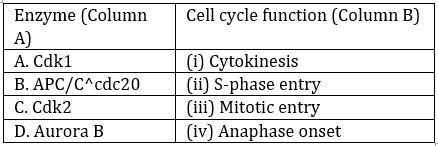
Correct option is B
Explanation-
The eukaryotic cell cycle consists of several phases:
G1 phase – Cell grows and prepares for DNA replication.
S phase – DNA replication occurs.
G2 phase – Cell prepares for mitosis.
M phase – Mitosis and cell division.
The transition from G1 phase to S phase is tightly regulated to ensure the cell is ready for DNA replication. This transition is called the G1/S checkpoint or restriction point.
The progression through the cell cycle is controlled by:
1. Cyclins – Regulatory proteins whose levels fluctuate during the cycle.
2. Cyclin-dependent kinases (Cdks) – Enzymes activated when bound to cyclins.
Each phase is regulated by specific Cdk-cyclin complexes.
G1 phase: In early G1, Cdk4/6-Cyclin D promotes progression.
Late G1 to S-phase transition (G1/S checkpoint): The Cdk2-Cyclin E complex is crucial. It phosphorylates the Rb protein, releasing E2F, which activates genes needed for DNA replication.
S-phase entry: Triggered after Cdk2/Cyclin E activation.
Thus, Cdk2/Cyclin E drives cells across the G1/S boundary into the S-phase.
Cdk2/Cyclin E is specifically required for the G1/S transition. Its activation is the final step before the cell enters the S phase. It commits the cell to DNA synthesis, which is an irreversible step in the cell cycle.
So, the correct answer is option b - Cdk2/Cyclin E